Learn how to grow your income with tips and ideas about direct selling and starting your own wellness store. Read success stories and simple guides to help you succeed.
Want to start an online business without investing in inventory? Our complete guide to dropshipping in India explains how to start, what to sell, and how to succeed in 2025. Find out how thousands of Indians are building profitable online stores with zero inventory risk.
Looking to start an online business without keeping stock? Learn how to start a dropshipping business in India that can earn you good money from home. With India's ecommerce market expected to reach USD 350 billion by 2030, now is the perfect time to start your zero-inventory business.
To start dropshipping in India in 2025, you need:
Basic Setup: Rs 0-20,000
Website Cost: Rs 0-1500/month
Marketing Budget: Rs 5000-10,000/month
GST Registration: Rs 1500-2000 (optional)
With platforms like Wcommerce, you can start dropshipping without investment.
What is Dropshipping?
Dropshipping is a retail business model where you sell products online without keeping any stock. When customers buy from your online store, the supplier ships products directly to them. Recent studies show that 41% of Indian consumers now prefer online shopping, making ecommerce dropshipping an attractive business option.
How Dropshipping Works in India:
You create your online store
Customer orders from your store
You forward the order to supplier
Supplier ships directly to customer
You keep the profit margin
Dropshipping Business Checklist for 2025
Essential requirements to start:
Business Plan
Choose niche
Research products
Set pricing strategy
Legal Requirements
Email Address
Bank Account
Technical Setup
Online Store
Payment Gateway
Social Media Accounts
Marketing Plan
Social Media Strategy
Content Plan
Advertising Budget
Why Choose B2C Dropshipping in India?
The dropshipping business model in India offers many benefits for passive income:
Low investment to start
No inventory management
Work from anywhere
No warehouse needed
Wide product selection
Easy scalability
Step-by-Step Guide to Start Dropshipping
1. Choose Your Niche
Want to start an online business without investment? First, select products that:
Have growing demand
Are easy to ship
Offer 30-40% margin
Have less local competition
Popular categories in online retail:
Health & wellness products
Beauty and skincare
Fashion accessories
Home decor
Electronics accessories
2. Find Reliable Partners
Look for platforms like Wcommerce that offer:
Quality products
On-time shipping
Return handling
Order tracking
Customer support
3. Set Up Your Online Store
Choose from:
Ready platforms (fastest start)
Shopify (easy but paid)
Custom website (needs technical knowledge)
4. Price Your Products Competitively
Remember to:
Check market prices
Include shipping costs
Consider platform fees
Keep 30-40% margin
Stay competitive
5. Market Your Online Store
Best promotion channels:
WhatsApp business groups
Facebook & Instagram
Google ads
Local community groups
Friends & family networks
Market Potential and Growth
Recent market research indicates:
35% annual growth in online retail
79% increase in first-time online shoppers
54% growth in tier 2-3 city orders
Dropshipping Market Statistics 2025
Recent data shows promising growth in Indian ecommerce:
Indian ecommerce market to reach $188 billion by 2025
74% of Indian consumers shop online regularly
Tier 2 and 3 cities show 82% growth in online shopping
Mobile commerce accounts for 67% of all online sales
Common Challenges in Indian Dropshipping
Shipping and Logistics
Choose lightweight products
Focus on high-value items
Work with reliable shipping partners
Payment Processing
Use trusted payment gateways
Offer multiple payment options
Keep delivery proof
Building Trust
Show real product photos
Give honest delivery times
Respond quickly to queries
Start Without Investment
Begin your journey with:
Ready platforms like Wcommerce
Social media marketing
Free promotion tools
Gradual growth plan
Legal Requirements
Basic needs:
GST registration (for pan-India selling)
Bank account
Email address
Success Tips for Online Retail
Start small, grow steadily
Test market demand
Focus on customer service
Keep learning
Build customer loyalty
Ready to Start Your Journey?
The Indian ecommerce space is growing rapidly, making it the perfect time to start your dropshipping business. With thousands of successful online store owners already earning good income, you too can build a profitable business.
Remember:
Choose trending products
Use reliable platforms
Provide excellent service
Market consistently
Stay patient
Frequently Asked Questions About Dropshipping in India
1. Is dropshipping legal in India?
Yes, dropshipping is completely legal in India. You need basic business registrations like PAN and GST (if turnover exceeds ₹20 lakhs annually).
2. How much money do I need to start dropshipping?
You can start dropshipping for free using platforms like Wcommerce. Optional costs include marketing (₹5000-10000/month) and business registration (₹1500-2000).
3. Do I need GST registration for dropshipping?
GST registration is mandatory if your annual turnover exceeds ₹20 lakhs. However, registering early helps build trust and allows pan-India business.
4. Which products are best for dropshipping in India?
Top performing categories include:
Health & wellness products
Beauty and skincare
Electronics accessories
Home decor items
Fashion accessories
5. How long does it take to earn profit?
Most dropshippers start seeing profits within 3-6 months with proper marketing. Successful dropshipping stores can earn ₹30,000-1,00,000 monthly.
6. Can I do dropshipping with a full-time job?
Yes, dropshipping can be managed part-time. Many successful store owners start as a side business while keeping their regular jobs.
Want to start your dropshipping business without investment? Create your free Wcommerce store today!
Selling online in India in 2026 is exciting, fast-moving, and full of opportunities. But let’s speak honestly, like two business friends having chai — every seller eventually faces the challenge of returns. One week you are happy seeing fresh orders, the next week you are processing refund requests, return orders, and customer complaints.
If you are a small or medium seller, especially working from a tier 2 or tier 3 city, this issue feels even heavier. You are not running a giant warehouse with separate teams. You are often doing everything yourself — listing products, packing parcels, answering customer messages, and managing returns.
So let’s break this down in simple, practical language.
No complicated theories. Just real reasons and realistic solutions.
How Big Is The Returns Problem In 2026?
Returns are no longer an occasional inconvenience. They are now a built-in part of online selling.
Across ecommerce markets worldwide, studies have repeatedly shown that roughly 20 percent of online purchases get returned. In categories like fashion and lifestyle, return rates often cross 30 percent because of sizing and expectation issues.
What does this mean for a seller in simple words?
If you ship 100 products, you may see 20 to 30 coming back.
For a small seller, that is not just numbers on paper. That is blocked money, double logistics cost, packaging waste, and extra workload.
In India, returns carry a few additional behavioural patterns that sellers must understand.
Why Returns Feel More Painful For Small Indian Sellers
Large marketplaces are designed to absorb return losses. Small businesses are not.
Each returned order usually means:
Cash stuck until reverse delivery completes
Courier charges paid twice
Risk of product damage
More customer complaints
Reduced profit margins
For many growing online sellers, reducing returns becomes more profitable than increasing sales.
What Exactly Is A Product Return?
A product return happens when a buyer sends back a delivered item and asks for a refund or replacement.
Returns are normal in ecommerce. But frequent return orders usually indicate deeper problems — unclear listings, mismatched expectations, quality concerns, or delivery confusion.
Understanding why customers return products is the first step toward prevention.
The Most Common Reasons Customers Return Products
Returns rarely happen without cause. Customers usually react to specific disappointments.
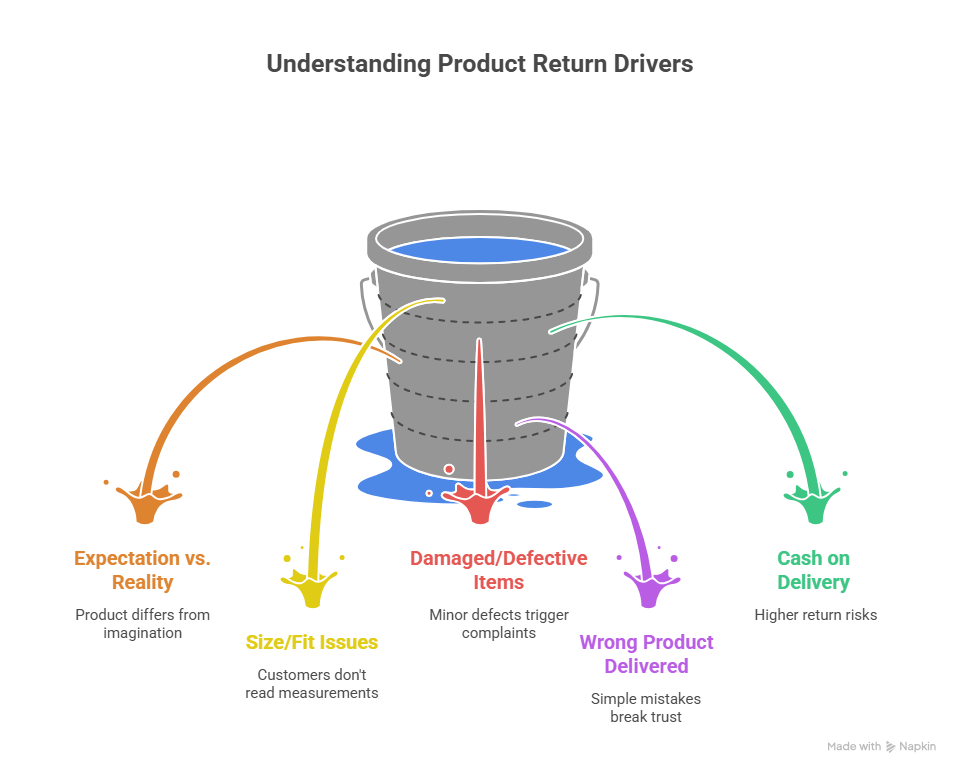
Expectation And Reality Do Not Match
This is one of the biggest drivers of return orders.
Online buyers depend heavily on product photos and short descriptions. If the delivered product looks different, feels different, or performs differently than imagined, dissatisfaction begins.
For example:
A buyer orders a “premium cotton shirt” expecting thick fabric but receives a lighter material. Even if the product is technically correct, perception drives the return.
This is why better product descriptions and visuals matter more than many sellers realise.
Size, Fit, Or Compatibility Issues
Very common in clothing, footwear, and accessories.
Many customers do not carefully read measurement details. Some order multiple sizes planning to return unwanted ones. In fashion categories, higher return percentages are now a well-known trend.
In smaller cities, buyers often rely more on images than technical specifications.
Accurate product information reduces returns significantly.
Damaged Or Defective Items
Even minor defects can trigger customer complaints and return requests.
From the buyer’s perspective, responsibility always lies with the seller. Courier mishandling is rarely considered by customers.
Strong packaging quietly plays a major role in reducing return orders.
Repeated fulfilment errors often result in rising customer complaints and falling repeat purchases.
Cash On Delivery Behaviour
Cash on delivery continues to influence buying decisions in India.
While customers love its convenience, sellers often face:
Delivery refusals
Higher return-to-origin cases
Casual return behaviour
Industry observations over recent years consistently highlight that cash on delivery orders usually carry higher return risks than prepaid ones.
For sellers, this is not about avoiding cash on delivery — it is about managing expectations better.
How To Prevent Returns Online Without Complicated Systems
Reducing returns is less about expensive software and more about clarity, honesty, and buyer psychology.
Optimise Product Pages For Fewer Returns
Think like a careful buyer.
Ask:
Do the images show true colour and texture?
Are dimensions or sizes clearly explained?
Is the description specific or vague?
Avoid generic phrases like “best quality.” Instead, describe what the buyer will actually receive.
Customers return products less when expectations are realistic.
Use Honest And Clear Visuals
Images shape buyer perception more than descriptions.
Include:
Multiple angles
Close-up shots
Real-life usage visuals
Size reference comparisons
Over-edited visuals may increase initial orders but often increase return orders later.
Improve Size And Specification Clarity
Whenever possible:
Provide measurement charts
Add compatibility details
Mention limitations clearly
Especially important for apparel and electronics.
Keep Return Policies Clear And Friendly
Confusing policies create distrust.
A good return policy:
Uses simple language
Clearly explains conditions
Avoids aggressive tone
Sets realistic timelines
Clarity reduces unnecessary customer complaints.
Communicate After Purchase
Post-purchase communication strategies are highly underrated.
A simple reassurance message can reduce confusion:
“Your order has been packed. Please review size and variant details in your order summary.”
Small gestures often prevent surprise-driven return orders.
Track Return Patterns And Reasons
Returns contain valuable feedback.
Even a basic tracking sheet noting:
Product returned
Reason given
Complaint details
can reveal powerful insights.
For example:
If many buyers say “colour looks different,” the issue may be product photos rather than product quality.
This is practical ecommerce returns data analysis — simple yet effective.
Handling Customer Complaints Without Stress
Returns frequently come with customer complaints. These interactions may feel tense, but calm communication works best.
A smart approach:
Acknowledge the concern
Avoid defensive language
Offer clear solutions
Maintain respectful tone
In India, seller behaviour strongly influences customer trust and repeat buying decisions.
Why Reducing Returns Improves Business Stability
High returns quietly damage business performance:
Profit margins shrink
Cash flow becomes unpredictable
Operational stress increases
Customer satisfaction drops
Research and industry studies repeatedly highlight that customer experience quality strongly affects repeat purchase behaviour. Fewer returns often indicate better trust and clearer expectations.
A Practical Perspective For Small Sellers In 2026
Returns are not disappearing anytime soon. Online buying behaviour continues to evolve, but customer expectations remain high.
Instead of viewing returns purely as losses, treat them as signals.
Each return silently answers:
“What did the customer expect but did not receive?”
An Alternative Many Sellers Now Consider
Today, many small businesses create their online stores using specialised platforms rather than managing everything manually. Some modern commerce platforms even handle complex processes like order returns and reverse logistics, allowing sellers to focus more on selling, marketing, and customer relationships instead of operational stress. For growing sellers, this often becomes a practical and less stressful alternative.
Conclusion
For Indian online sellers, most return orders are predictable and preventable. They usually stem from unclear listings, expectation gaps, sizing confusion, and communication gaps.
A smarter strategy is not just increasing sales, but actively working to reduce returns through better clarity and consistency.
Two realistic actions you can take immediately:
Review your most returned products honestly
Improve descriptions and visuals with realistic details
Small improvements here often produce stronger financial impact than many promotional efforts.
In 2026, running an online store is no longer unusual. From small towns to growing cities, thousands of sellers are building businesses through websites, instagram pages, and whatsapp catalogues. Technology has made selling easier, but understanding business numbers still remains a major challenge for beginners.
When people hear the phrase business analytics, they often imagine complicated tools, technical reports, and confusing dashboards. This perception discourages many small sellers from tracking anything at all.
But here is the truth.
Business analytics, especially for small sellers, is simply about understanding what is happening inside your business. It is about replacing guesswork with clarity.
You do not need advanced software to do this. You just need the right mindset and a few simple tracking habits.
Why business analytics matters even more in 2026
Online competition continues to increase every year. Customers have more choices. Costs are rising. Margins are tighter. In such an environment, decisions based on assumptions can become expensive.
Without business performance tracking, many sellers stay busy but feel uncertain.
According to ministry of commerce and industry data and various startup ecosystem studies, India continues to see rapid growth in digital commerce participation, especially among small businesses. What this means practically is simple: more sellers are entering the market, which increases the need for smarter decision making.
Business analytics does not mean complicated tools
Large companies use complex analytics systems. Small sellers do not need that level of sophistication.
For beginners, small business data tracking can be done using extremely simple tools.
The goal is not perfection.
The goal is awareness.
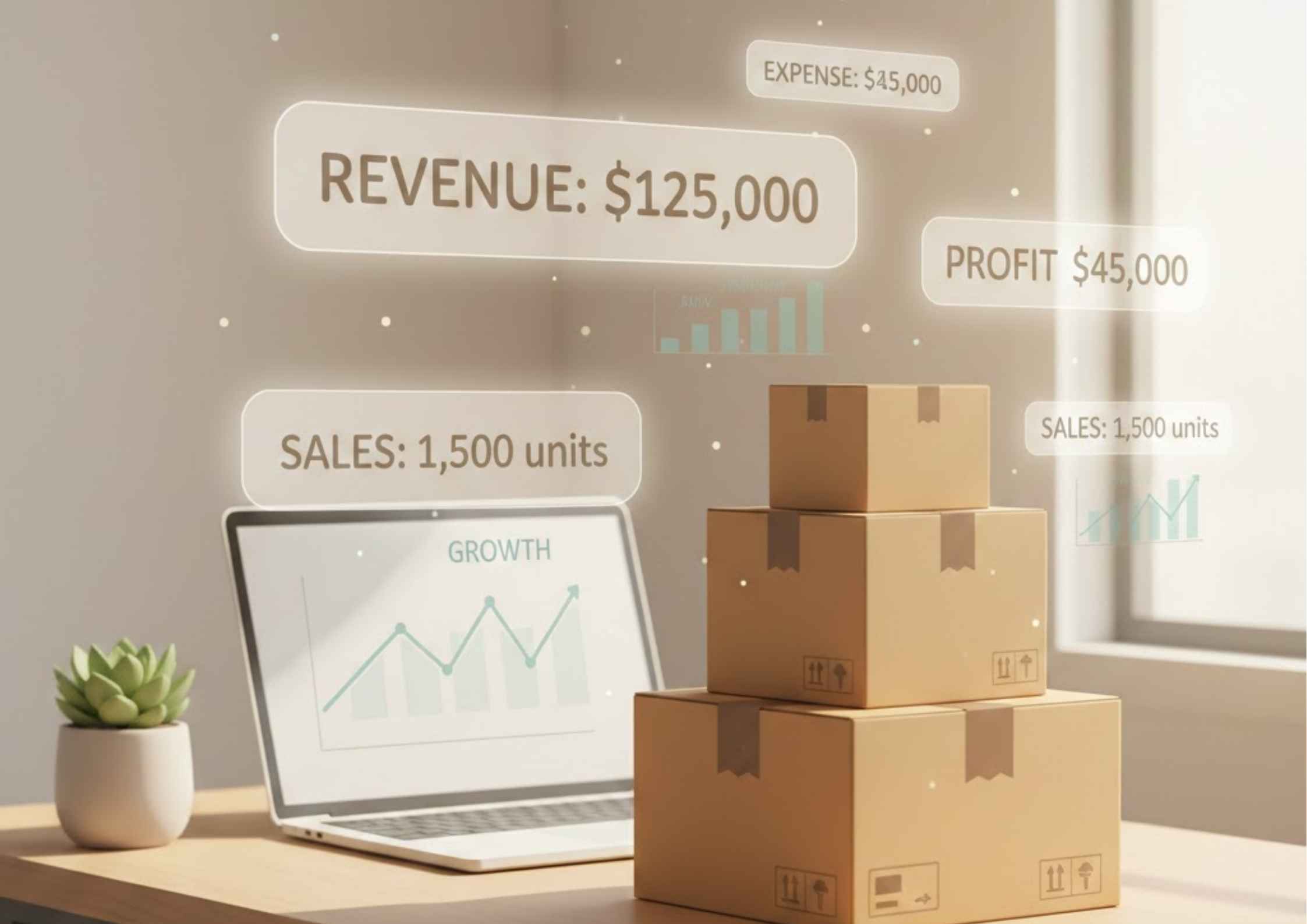
The most important number to track: revenue
Revenue is the total value of sales generated.
If you sell products worth ₹5,000 today, your revenue is ₹5,000.
This basic revenue and profit tracking prevents a very common beginner mistake — assuming sales equal success.
Sales tracking that requires no special software
Many beginners believe they need tools for sales tracking.
In reality, a simple spreadsheet works perfectly.
Daily tracking fields:
product sold
quantity
selling price
profit
This becomes one of the most effective simple sales tracking methods.
Consistency matters more than complexity.
Expense tracking: where profits quietly disappear
Expenses are often underestimated because individual amounts feel small.
Common overlooked expenses:
courier charges
packaging materials
transaction fees
miscellaneous spending
How to track expenses:
Create a separate sheet inside google sheets.
Columns:
date
expense type
amount
notes
Regular expense and cash flow tracking protects business stability. When expenses are visible, pricing decisions improve naturally.
Cash flow: the stress management metric
Cash flow is about timing of money movement.
Even profitable sellers can face difficulties if funds are locked in unsold inventory or delayed payments.
Basic tracking approach:
Monitor:
total money received
total money spent
pending payments
This avoids sudden shortages and panic decisions.
Product performance analysis: identifying winners and weak spots
Not all products contribute equally.
Some products generate:
frequent sales
higher margins
repeat buyers
Others consume capital without sufficient movement.
How to track product performance:
Inside your google sheet, use simple sorting.
Check:
most frequently sold items
highest profit items
slow-moving products
This practical product performance analysis helps sellers optimise inventory and reduce wasteful stocking.
Customer behaviour tracking: understanding your buyers
Customers provide powerful business signals.
Key observations:
repeat purchase patterns
preferred products
common objections
frequent questions
Simple tracking method:
Maintain a small record of repeat customers.
Columns:
customer name
products purchased
frequency
This basic customer behaviour tracking improves targeting and product decisions.
Ecommerce metrics for beginners that truly matter
Forget complicated terminology.
Beginners benefit most from tracking:
daily or weekly sales consistency
average profit per order
repeat customer presence
expense trends
product movement patterns
These simple ecommerce metrics for beginners provide more clarity than many realise.
Where google analytics fits in (without overcomplicating things)
Tools like google analytics are useful, but beginners should approach them calmly.
Google analytics primarily helps track:
visitor numbers
traffic sources
popular pages
basic user behaviour
Even minimal usage can be valuable.
For example:
Checking:
how many visitors your site gets
which pages attract attention
This does not require deep technical knowledge.
However, analytics tools work best when sellers already understand their basic business numbers. Without revenue, profit, and expense clarity, digital metrics can feel abstract.
Why simple tracking beats delayed sophistication
Many beginners postpone analytics because they want ideal systems.
Delayed tracking leads to delayed learning.
A basic spreadsheet updated regularly is far more useful than a perfect system never used.
Signs your online store is growing
Growth is often subtle.
Look for patterns like:
improving order frequency
better profit consistency
increasing repeat buyers
clearer product demand
These practical signs your online store is growing indicate healthy progress.
Building a sustainable analytics habit
Business analytics is not about mathematics. It is about awareness and discipline.
Spend a few minutes regularly:
update sales
record expenses
review profit
observe trends
Over time, numbers begin to tell a clear story.
A practical reality for modern sellers
Today’s selling environment offers another advantage. Many online store platforms now provide built-in dashboards that simplify tracking. Sellers can quickly check orders, monitor performance, and view basic reports without setting up complex systems.
As businesses grow, these systems can often be connected with tools like google analytics for deeper tracking and behaviour insights.
The key idea remains unchanged.
Strong businesses are built on clarity.
Conclusion
In 2026, business analytics for small sellers does not require expensive tools or technical expertise. It begins with tracking simple, meaningful numbers using free and accessible tools like google sheets. This becomes even more important when dealing with challenges discussed in why customers return products in India and how to reduce returns, where data and patterns often reveal the real problems behind return orders.
Focus on revenue, profit, expenses, products, and customers. Build a consistent tracking habit. As your store matures, advanced tools can enhance insights, but foundational clarity must come first.
A seller who understands their numbers always operates with greater confidence, stability, and control.
References
Influencermarketinghub industry observations, 2023
Statista digital commerce and consumer behaviour reports
Ministry of commerce and industry, government of India
Marious small business and ecommerce adoption studies
Why your new online store does not need ads to grow in 2026
Starting an online store in 2026 is both easier and harder than before.
Easier, because technology has simplified everything. You can build a website quickly, list products, accept payments, and start selling within days. Harder, because competition is everywhere. Thousands of sellers are fighting for attention on the same platforms.
Most beginners experience the same frustration.
You launch your store with excitement. You share links with friends. You post on social media. Then days pass. Hardly any visitors. Very few orders. Eventually, you hear the most common advice — “run ads”.
For many new sellers, especially those working with very small budgets, ads are not always the right first step. Paid campaigns can be unpredictable. Costs are rising. Margins are tight. One mistake can drain valuable capital.
This is exactly where small content creators become extremely relevant in 2026.
Let us explore this in a practical, realistic, beginner-friendly way.
Why this topic matters even more today
Consumer behaviour has changed dramatically over the past few years. People now spend a large part of their day watching short videos, reels, and creator content. Instead of discovering products through traditional advertisements, they often encounter them through individuals they follow.
This shift is part of what many industry experts describe as the creator economy for ecommerce — a digital environment where creators influence what audiences notice, trust, and buy.
According to Influencermarketinghub’s industry report in 2023, the global influencer marketing industry crossed 21 billion dollars. For a small store owner, the number itself is not the main point. The real takeaway is the direction of the trend.
Businesses are increasingly investing in creators rather than depending only on ads.
For beginners with limited funds, this opens a highly practical opportunity.
What is a content creator in simple words
A content creator is simply someone who regularly posts videos, photos, or posts online and has an audience that pays attention to their content.
They are not always celebrities.
They may be:
a local fashion enthusiast
a skincare reviewer
a fitness lover sharing reels
a student creating lifestyle videos
a small YouTube channel owner
a niche hobby page
Their value lies in audience attention and trust.
Followers often view creators as relatable individuals rather than distant brands. This builds a level of credibility that advertisements struggle to achieve.
Why small creators work better for new stores
Many beginners dream of collaborating with large influencers. Big names feel attractive. Large follower counts appear impressive.
However, smaller creators frequently deliver better outcomes for new stores.
Why?
First, their audience connection feels more personal. Followers interact, comment, and engage more genuinely. This helps build audience trust through authentic creators, which is extremely important when your brand is unknown.
Second, smaller creators are easier to approach. They respond to messages. They experiment with collaborations. They are more open to flexible arrangements.
Third, costs are usually manageable for beginners.
How much do small creators typically charge in 2026
Influencer marketing is often misunderstood as expensive. That assumption mainly comes from observing large creators.
Smaller creators operate very differently.
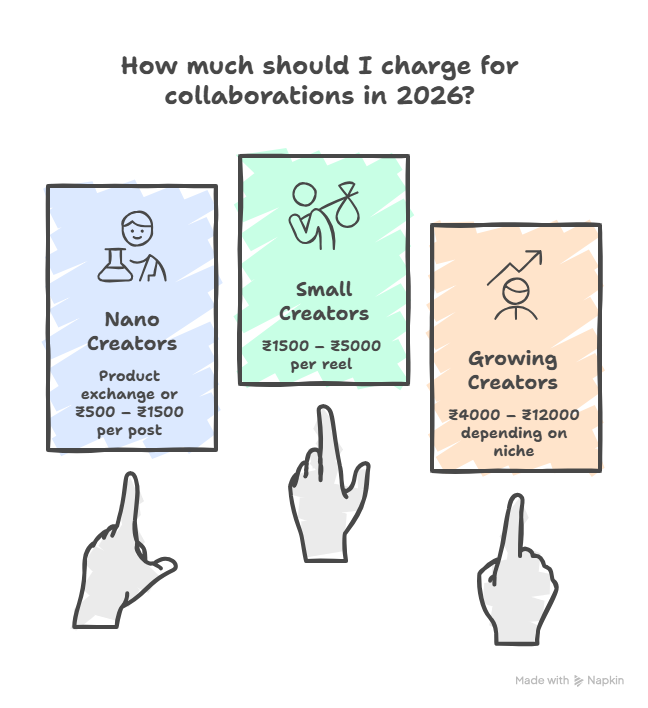
Broad practical collaboration ranges in India often look like this (general market observations, not strict rules):
nano creators (1k – 5k followers): product exchange or roughly ₹500 – ₹1500 per post
small creators (5k – 20k followers): roughly ₹1500 – ₹5000 per reel
Many creators accept free products, especially if the product fits their content style and audience.
For low-budget sellers, product-based content creator collaborations can be an excellent starting point.
Why this works better than social media marketing without ads
Posting on your own social media page is necessary, but reach is limited when your account is new. Algorithms favour engagement history and established profiles.
Creators already possess visibility.
Collaborating with them allows you to tap into audiences that are already active. This makes creator partnerships one of the most practical forms of social media marketing without ads.
Instead of waiting months for organic growth, you gain immediate exposure.
How to actually find and contact content creators in real life
Understanding the strategy is one thing. Executing it is another.
Beginners often struggle with the first step — where do you actually find creators and how do you contact them?
The process is far simpler than it appears.
Finding creators on Instagram
Instagram remains one of the easiest platforms to discover small video creators.
Simple discovery methods:
search niche hashtags related to your product
explore reels in your category
check competitor tagged posts
browse suggested accounts
Once you find a potential creator, review their profile carefully.
Look for:
posting consistency
content quality
genuine engagement
audience relevance
Do not focus only on follower count.
A creator with a smaller but engaged audience can be far more valuable.
Checking Instagram bio for contact details
Many creators share business information directly in their bio.
You may find:
email address
WhatsApp link
website link
management contact
If an email is listed, sending a polite message is usually appropriate.
If no contact details are visible, direct messaging is completely normal.
How to send a proper direct message
Keep your message human and respectful.
Example:
“Hi, I recently saw your page and liked your content. I have started a small online store and feel my product may suit your audience. Would you be open to discussing a simple collaboration?”
No pressure. No aggressive sales tone.
Creators respond better to genuine communication.
Finding creators on YouTube
Youtube is another powerful platform, particularly for niches where detailed explanations matter.
Search using:
product keywords
review videos
niche topics
regional language queries
Once you open a channel, go to the about section.
Many beginners overlook this.
Creators frequently list business email addresses here.
Writing a simple outreach email
Emails should be brief and clear.
Avoid sounding like a large corporate brand.
Example structure:
introduce yourself
mention appreciation for their content
explain your store briefly
propose collaboration
Authenticity works better than formality.
Should you call creators directly
Some creators provide phone numbers or WhatsApp links.
Calling can work, but basic etiquette is important.
Good approach:
send a message first if possible
introduce yourself clearly
keep the call concise
respect their time
Unexpected calls without context may feel intrusive.
How to judge if a creator is worth collaborating with
Choosing creators can feel confusing for beginners.
Instead of overthinking, use simple filters:
audience relevance matters most
engagement quality is critical
consistency indicates seriousness
Even creators with modest audiences can generate strong results if trust is high.
What type of collaborations work best for beginners
Keep collaborations simple and low risk.
Beginner-friendly models:
free product for honest content
small payment plus product
commission per sale
discount codes
If budgets are limited, product-based partnerships are often ideal.
This also supports effective UGC strategies, where creators generate natural content for your brand.
Why creator content builds buyer confidence
New stores struggle primarily with trust.
Unknown brands naturally trigger hesitation. Creator content reduces this friction. When audiences see a familiar individual using or discussing a product, confidence increases.
This is how sellers gradually boost sales with creator content without heavy advertising.
Common mistakes beginners should avoid
Even strong strategies fail when expectations are unrealistic.
Avoid:
selecting creators only by followers
expecting instant viral sales
sending spam-like messages
ignoring audience relevance
overcomplicating agreements
Influencer marketing is a gradual visibility-building process.
A simple weekly action plan for beginners
Consistency is more important than perfection.
Every week:
discover 10 to 15 creators
shortlist relevant profiles
check bio or about section
send polite outreach messages
track responses
Over time, this steady effort compounds.
Why this approach suits small Indian sellers
For many sellers, aggressive ad spending feels risky. Creator partnerships offer flexibility.
You can:
start small
control costs
test gradually
use products instead of cash
When you pair creator collaborations with simple business analytics— such as tracking engagement, conversions, and responses — decision-making becomes far more confident and less emotional.
This makes creator-driven promotion one of the most realistic small business marketing ideas online.
Conclusion
In 2026, small content creators are not an optional tactic. For beginners with limited budgets, they represent one of the most practical growth channels.
Instead of focusing only on ads, focus on attention and trust. Identify creators your audience already follows. Start simple collaborations. Learn from responses. Scale gradually.
For many new store owners, steady creator partnerships can deliver more stable and sustainable growth than unpredictable advertising campaigns.
References
Influencermarketinghub industry report, 2023
Salesforce creator economy insights
Statista digital consumer behaviour studies
Various publicly discussed small business marketing trends
Why every small business needs to promote for free in the beginning
Starting a business without money for ads is not new in India. For years, kirana stores, home bakers, tailors, and local service providers have grown through trust, visibility, and word of mouth. Even in 2026, the basics have not changed. What has changed is that you now have many free digital tools to speed up this process.
If you are here, you have already done important groundwork. Your store is live, your Instagram page is active, you have posted consistently using a simple content plan, converted dms into first orders, and started keeping customers close through WhatsApp. Now the focus shifts to one clear goal: how to promote for free and reach your first 100 customers without spending money.
This guide shares zero-budget marketing ideas that are practical, realistic, and suitable for Indian small businesses, especially in tier 2 and tier 3 cities.
What zero budget marketing really means in 2026
Zero budget marketing does not mean shortcuts. It means replacing money with effort, clarity, and repetition.
From analysing top-performing global blogs, one thing is clear: businesses that grow without ads focus on distribution, not just content. They reuse the same message in multiple places instead of creating something new every time.
In simple terms, zero budget marketing ideas focus on:
using free platforms properly
repeating your message consistently
staying visible without being noisy
following up manually
This approach works best in the early stage.
Why free promotion still works for small businesses
According to DataReportal’s digital India report 2025, India has crossed 800 million internet users, and a large portion of them discover small businesses through social media, search, or direct messages. This tells us something important: customers are already online, but attention is limited.
Free promotion matters because it allows you to test what works without financial pressure. It helps you understand:
what kind of posts get replies
what questions customers ask repeatedly
what makes people trust you
This learning is more valuable than running ads too early.
Start promotion with people you already know
Almost every successful small business starts here, but many beginners skip it.
Your first promotion circle should include:
friends and family
neighbours and colleagues
old customers
people who already trust you
Send a personal message, not a broadcast.
Example:
“hi, i’ve started selling handmade notebooks online. sharing my page here in case you or someone you know finds it useful.”
This builds early engagement and confidence.
Reuse one piece of content across platforms
Top global blogs consistently highlight this: do not create new content for every platform.
One post can be reused as:
Instagram post
Instagram reel cover
WhatsApp status
WhatsApp community update
dm follow up image
This is social media promotion without spending money.
Free tools to create content
If you do not have professional photos, free ai tools help.
Gemini (free)
Use it to generate simple product visuals.
Copy-paste prompt:
create a realistic product image for a small Indian business, clean background, natural lighting, suitable for Instagram post
ChatGPT (free)
Use it to write captions and short descriptions.
Copy-paste prompt:
write a simple, friendly Instagram caption for a small Indian business product, easy Indian English, no sales pressure
Edit the final image or text using Canva free and post confidently.
Use WhatsApp status as a free daily billboard
WhatsApp status is one of the most underused free promotion tools.
People who already have your number see it:
family
friends
customers
suppliers
Post:
product photos
packing updates
customer messages
new stock announcements
Over time, people start replying naturally.
Use comments and replies as promotion
From analysing top-ranking blogs, one tactic stands out: active participation beats posting alone.
Spend 15–20 minutes daily:
replying to comments
answering questions
commenting genuinely on relevant posts
Do not sell in comments. Be helpful. People check profiles before buying.
Free tools that help you stay consistent
Consistency is harder than creativity.
Free tools that help:
google calendar to plan posts
google sheets to track what you posted
notes app for caption drafts
Simple systems beat complex tools in zero-budget marketing.
Manual follow up marketing still converts
Almost all high-ranking guides mention follow ups, but few explain how simple they should be.
A polite follow up message works:
“hi, just checking if you had a chance to see the product. happy to help if you have questions.”
No discounts. No pressure.
Manual follow up marketing builds trust, especially in Indian markets.
How to realistically reach your first 100 customers
Your first 100 customers usually come in phases:
first 20 from personal network
next 30 from Instagram content and dms
next 30 from WhatsApp community and referrals
last 20 from consistent visibility and follow ups
This pace is normal. Do not rush it.
Why repetition matters more than new ideas
One key insight from top blogs is repetition.
People rarely buy the first time they see something. They buy when they recognise it.
Posting the same message in different formats is not boring. It is necessary.
This is organic marketing for beginners.
How to promote without sounding salesy
Good marketing feels like conversation.
Instead of pushing offers:
explain how your product helps
show how to use it
share why customers like it
Trust grows when people feel informed, not chased.
Common mistakes in free promotion
Avoid these:
changing strategy every week
copying big brands blindly
stopping after low response
expecting instant results
Zero budget marketing ideas reward patience.
Conclusion
To promote for free and reach your first 100 customers, focus on visibility, consistency, and trust. Use free tools, reuse content smartly, follow up politely, and stay present.
In 2026, zero-budget marketing is not about hacks. It is about showing up regularly and helping people understand what you offer. Build slowly, learn from responses, and grow without pressure. This foundation will support your business long after you start spending on ads.
As your store begins to gain attention, many sellers also explore how to use small content creators to grow your online store without ads, since creator-driven visibility can significantly accelerate early growth without increasing marketing costs.
Getting orders once, then starting from zero again
Getting your first few orders feels exciting. But for most small businesses, the real challenge starts after that. Orders come once, then disappear. Every new month feels like starting from zero again. This is where a WhatsApp community becomes extremely useful for Indian sellers. Not as a place to push offers, but as a space to build familiarity, trust, and repeat buying over time.
This guide is written for small business owners, home sellers, shop owners, and online sellers in tier 2 and tier 3 cities who want steady monthly orders without ads or complicated tools.
What a WhatsApp community actually means for a small business
A WhatsApp community is a structured space where customers stay connected with your business even after they have purchased once.
Instead of chasing customers again and again, you create one place where:
updates are shared
trust grows slowly
repeat buying becomes natural
The WhatsApp communities feature allows you to manage this in an organised way, without running multiple confusing groups.
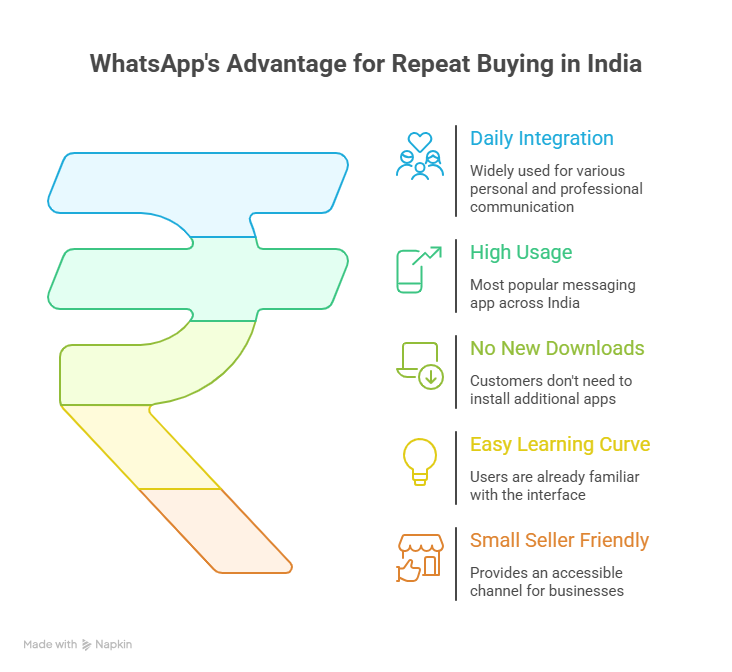
Why WhatsApp works best for repeat buying in India
WhatsApp is already part of daily Indian life. People use it for family groups, school messages, office work, housing societies, and local shops.
According to datareportal 2025, WhatsApp continues to be the most used messaging app in India across cities and towns. This matters because customers do not need to download anything new or learn a new app to stay connected with your business.
For a small seller, this makes WhatsApp the easiest channel to stay remembered.
Step 1: decide who your WhatsApp community is for
Do not start by adding everyone.
Start by deciding clearly:
who should be inside this community
why they should stay
Example:
If you sell women’s kurtis, your community is for women who have already bought once or shown serious interest.
If you run a home bakery, your community is for repeat customers and festival buyers.
Clarity here avoids noise later.
Step 2: create your first WhatsApp community properly
Create one WhatsApp community with:
one announcement group
one discussion group
Name it clearly and respectfully.
Example names:
“Sharma saree customers”
“Anaya bakery updates”
“Local organic grocery buyers”
Avoid names like “best offers” or “discount group”. They reduce trust.
Step 3: add only trusted people in the beginning
Start small. Even 15 to 30 people are enough.
Add:
customers who have already purchased
people who gave positive feedback
local buyers you know personally
Always inform them before adding. A simple message like:
“we share updates and early info here, would you like to join?”
Permission builds trust.
Step 4: what to share inside the community
Many sellers fail here by posting only offers.
A healthy WhatsApp community includes:
new stock or restock updates
simple usage or care tips
behind-the-scenes work
customer feedback
occasional offers
Example:
If you sell skincare, share how to use it properly.
If you sell clothing, share fabric care tips.
If you sell food, share storage or reheating tips.
This keeps the group useful, not irritating.
Step 5: how often to message without annoying people
For most Indian customers:
2 to 3 messages per week is enough
Daily messages feel overwhelming and lead to muting.
Consistency matters more than frequency. Customers should feel you are present, not chasing them.
Step 6: how to promote your WhatsApp community locally
This is the most important missing step for most sellers.
Start local. Do not think digital first.
Ways that actually work in India:
Posters and printouts
Place a small poster near your counter or packing area:
“join our WhatsApp community for updates and early access”
QR codes
Create a simple WhatsApp join link and convert it into a qr code.
Paste it on:
shop counter
visiting cards
bills or invoices
packaging boxes
Ask at delivery time
When delivering an order, ask politely:
“can i add you to our WhatsApp community for updates?”
Local word of mouth
Once 10–15 people join, growth becomes natural. Satisfied customers forward the link themselves. In tier 2 and tier 3 cities, word of mouth works better than ads even in 2026.
Step 7: encourage monthly buying without pushing sales
Monthly buying happens when customers feel comfortable returning.
You can encourage this by:
giving community members early access
sharing upcoming launches in advance
thanking repeat buyers publicly in the group
adding small handwritten notes for community members
These actions build emotional connection, not pressure.
Common mistakes that break WhatsApp community trust
Avoid these mistakes:
adding people without asking
sending too many promotional messages
ignoring replies or questions
forwarding unrelated content
Once trust breaks, people leave silently.
How this fits your overall selling journey
For most small sellers, the journey looks like this:
content brings attention
Instagram dm brings first orders
WhatsApp community brings repeat orders
Each step has its role. The WhatsApp community is about care, not chasing.
When to expect results realistically
Do not expect instant monthly sales.
In the first month, engagement increases.
In the second or third month, repeat orders start.
This slow but stable growth is healthier than running discounts every week.
Conclusion
A WhatsApp community is not built in one day. It grows through patience, respect, and consistency.
If you want loyal customers who buy every month, focus on building a calm, useful WhatsApp community instead of pushing offers. Start small, grow locally, and let trust do the work.
For sellers who are still working on initial visibility, understanding how to promote for free can be an equally important step after community-led growth begins.
That is how Indian small businesses build steady income in 2026.
Gettingviews on reels feels good. Notifications start coming in, likes increase, and a few people even send messages. But many new sellers get stuck at this exact stage. Views are there, DMs are coming, yet orders are not getting confirmed.
This gap between interest and purchase is where most beginners feel confused. They ask the same question again and again: people are messaging me, but how do i convert these Instagram DMs conversations into real orders?
This guide is written for new ecommerce sellers who have already started posting reels and are now receiving DMs. It focuses on what really matters at this stage: talking properly, building trust, and fulfilling the order in a way that makes the customer feel confident.
Why Instagram DMs matters more than views
Instagram DMs is where real selling begins. A reel may bring attention, but the DMs is where the decision happens. In simple terms, Instagram DMs is the private space where a customer feels comfortable asking questions. This is where doubts about price, quality, delivery, and trust come out.
Messaging has quietly become the most common way people talk to businesses online. Meta shared in 2023 that users and businesses exchange over 600 million messages every day across its apps. At the same time, DataReportal reported that global social media usage reached around 5.66 billion user identities by late 2025. For a small seller, this simply means customers are already comfortable sending messages instead of calling or filling forms. If you handle Instagram DMs replies properly, it becomes a direct and free way to reach real customers without spending on ads.
What Instagram DMs conversion really means
Instagram DMs conversion means turning a conversation into a confirmed order. It does not mean forcing a sale or pushing offers. It means guiding a person from curiosity to confidence.
For beginners, converting DMs into orders depends on three things:
how you reply
how clearly you explain
how much trust you build
How to reply to Instagram DMs in the early days
Many sellers lose orders because of small reply mistakes. When someone sends a DMs after watching your reel, they are already interested. Your reply should feel human, not rushed or copied.
A good first reply should:
acknowledge the message (thank them for the interest)
answer the main question clearly (price, size, availability)
invite the next step gently (ask if they want to place the order or need help with size)
Example: “Thanks for your message, Priya — this tee is cotton, size m available. Total is ₹499 including basic packing. Would you like me to reserve one in m for you?” This small, friendly framing reduces doubt and moves the conversation forward.
Manual DMs selling for beginners works best
At this stage, manual DMs selling for beginners is better than automation. You do not need tools or auto replies for your first orders. What you need is attention. Replying on time shows seriousness. Using the customer’s name shows respect. Answering patiently shows reliability. Many top blogs discuss automation for scaling, but automation works only when volume is high. For your first 10–50 orders, personal replies convert better than smart systems.
Building trust in Instagram DM step by step
Trust is the biggest reason people buy from small sellers.
You can build trust in Instagram DMs by doing simple things:
share clear product details and close-up images
be honest about delivery timelines and extra charges
answer follow-up questions without irritation
confirm details before taking payment
Trust grows when customers feel you are not hiding anything. Small actions like giving a tracking number, sending a dispatch photo, or telling them exactly when the courier will arrive make a big difference.
From DMs to order confirmation without confusion
The Instagram DMs selling process should feel smooth, not stressful.
Once a customer shows interest, move towards order confirmation clearly:
restate the product name and variant (size, colour)
confirm total price including delivery and any taxes
explain payment method and how refund/return works
share expected dispatch and delivery window
This step reduces cancellations and complaints. A clear short message like: “Confirming your order: red tee, size m, ₹499 total. Payment by upi or cash on delivery? Dispatch in 2 days, delivery in 5–7 days” keeps things simple and professional.
Instagram DMs follow up without sounding pushy
Not every DMs converts immediately. Some people read and disappear.
Instagram DMs follow up is important, but it should be gentle.
A good follow up cadence:
first follow up: 12–24 hours after initial message if no reply
second follow up: 2–3 days later with a helpful note (new stock info or sizing tip)
final follow up: 5–7 days later as a courteous check-in
Example follow up: “Hi Rahul, checking if you need any help with the size. I can send a quick size chart or hold one unit until tomorrow.” This keeps the tone helpful, not pushy.
Personalised selling on Instagram creates strong first impressions
Small gestures create big impact in early orders.
Personalised selling on Instagram can be as simple as:
adding the customer’s name on a small thank you note
packing the product neatly and securely
including a handwritten message or a small name card inside the parcel
These actions make customers feel valued. Many first-time buyers become repeat buyers because of the experience, not because of discounts.
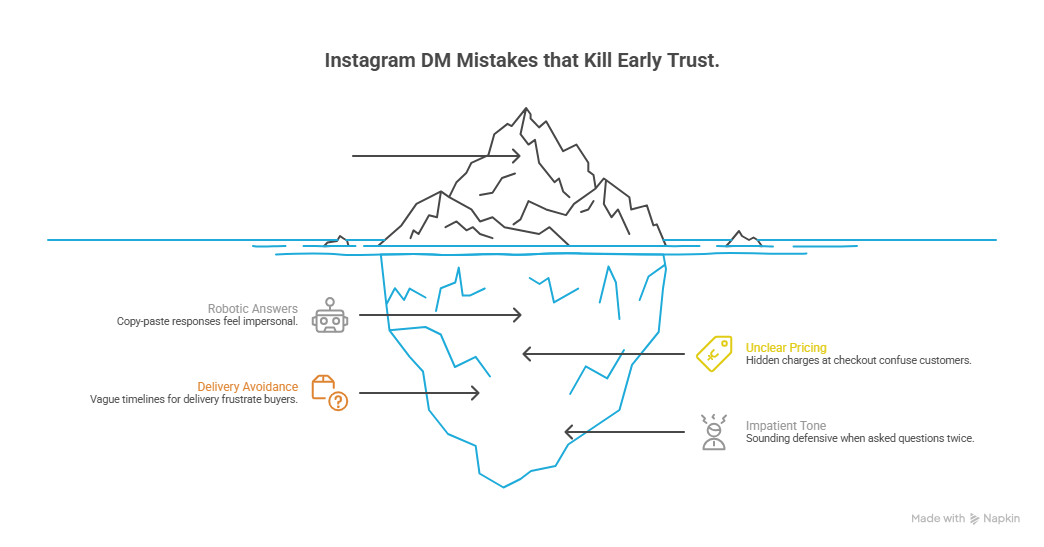
Common Instagram DMs mistakes that break early trust
Some mistakes silently kill conversions.
Common Instagram DMs mistakes include:
delayed replies or long gaps between messages
copy-paste answers that feel robotic
unclear pricing or hidden charges at checkout
avoiding delivery questions or giving vague timelines
sounding impatient or defensive when asked the same question twice
Being aware of these helps you avoid them and keep the sale on track.
At this stage, the goal is not speed or scale, but trust.
Since these are the first few orders, replying to every Instagram DMs manually and on time is more important than using tools or automation. A simple, polite conversation, clear pricing, and honest delivery timelines convert better than smart tricks. Small actions like confirming details properly, packing carefully, and adding a handwritten note or name card help new sellers build strong early trust.
Practical DMs scripts sellers can copy
Use short, natural messages. Edit the words so they sound like you.
first reply when asked price: “thanks for asking, the price for this saree is ₹1199 including simple packing. we can ship in 2 days. shall i reserve one for you?”
when a customer asks about sizing: “this tee is true to size. i usually recommend size up if you like loose fit. i can share a quick size chart if you want.”
confirming order: “order confirmed — blue tee size m. total ₹499. please send payment by upi to xxxxxx or reply 'cod' for cash on delivery. i'll pack and share tracking when dispatched.”
polite follow up: “hi, i wanted to check if you still need this. i can hold it till tomorrow if you want.”
These scripts keep the conversation human and clear.
Why this approach works for Indian small sellers
In tier 2 and tier 3 cities, people still value conversation and reassurance. Customers often compare online sellers to local shopkeepers they trust. When you reply patiently and deliver what you promise, you stand out. This is also a form of free marketing. Happy customers talk, share, and recommend. This helps you get customers without ads — real practical free marketing for your small business.
What to do after the first order is confirmed
Once a customer places their first order through Instagram DMs, the next step is keeping them close. This is where building a WhatsApp community for repeat customers helps small sellers turn one-time buyers into regular monthly orders.
Conclusion
Instagram DMs is not just a messaging feature. It is the most important selling space for new online businesses. If you want to convert reel views into confirmed orders, focus on how you talk, how you explain, and how you deliver. Manual replies, honest communication, and small personal touches build trust faster than any tool.
Your next two actions: 1) open your DMs, now and set a simple reply routine — respond within a few hours, and 2) prepare a small packing kit with a thank you note to include with the next order. These little steps will increase the chance that a DMs becomes a happy customer.
Create your store with Wcommerce today and enjoy a zero subscription fee forever. Don't miss this exclusive opportunity to maximize your earnings without any monthly costs.


.jpg)
.png)



.jpg)
.jpg)
