Learn how to grow your income with tips and ideas about direct selling and starting your own wellness store. Read success stories and simple guides to help you succeed.
Want to start an online business without investing in inventory? Our complete guide to dropshipping in India explains how to start, what to sell, and how to succeed in 2025. Find out how thousands of Indians are building profitable online stores with zero inventory risk.
Looking to start an online business without keeping stock? Learn how to start a dropshipping business in India that can earn you good money from home. With India's ecommerce market expected to reach USD 350 billion by 2030, now is the perfect time to start your zero-inventory business.
To start dropshipping in India in 2025, you need:
Basic Setup: Rs 0-20,000
Website Cost: Rs 0-1500/month
Marketing Budget: Rs 5000-10,000/month
GST Registration: Rs 1500-2000 (optional)
With platforms like Wcommerce, you can start dropshipping without investment.
What is Dropshipping?
Dropshipping is a retail business model where you sell products online without keeping any stock. When customers buy from your online store, the supplier ships products directly to them. Recent studies show that 41% of Indian consumers now prefer online shopping, making ecommerce dropshipping an attractive business option.
How Dropshipping Works in India:
You create your online store
Customer orders from your store
You forward the order to supplier
Supplier ships directly to customer
You keep the profit margin
Dropshipping Business Checklist for 2025
Essential requirements to start:
Business Plan
Choose niche
Research products
Set pricing strategy
Legal Requirements
Email Address
Bank Account
Technical Setup
Online Store
Payment Gateway
Social Media Accounts
Marketing Plan
Social Media Strategy
Content Plan
Advertising Budget
Why Choose B2C Dropshipping in India?
The dropshipping business model in India offers many benefits for passive income:
Low investment to start
No inventory management
Work from anywhere
No warehouse needed
Wide product selection
Easy scalability
Step-by-Step Guide to Start Dropshipping
1. Choose Your Niche
Want to start an online business without investment? First, select products that:
Have growing demand
Are easy to ship
Offer 30-40% margin
Have less local competition
Popular categories in online retail:
Health & wellness products
Beauty and skincare
Fashion accessories
Home decor
Electronics accessories
2. Find Reliable Partners
Look for platforms like Wcommerce that offer:
Quality products
On-time shipping
Return handling
Order tracking
Customer support
3. Set Up Your Online Store
Choose from:
Ready platforms (fastest start)
Shopify (easy but paid)
Custom website (needs technical knowledge)
4. Price Your Products Competitively
Remember to:
Check market prices
Include shipping costs
Consider platform fees
Keep 30-40% margin
Stay competitive
5. Market Your Online Store
Best promotion channels:
WhatsApp business groups
Facebook & Instagram
Google ads
Local community groups
Friends & family networks
Market Potential and Growth
Recent market research indicates:
35% annual growth in online retail
79% increase in first-time online shoppers
54% growth in tier 2-3 city orders
Dropshipping Market Statistics 2025
Recent data shows promising growth in Indian ecommerce:
Indian ecommerce market to reach $188 billion by 2025
74% of Indian consumers shop online regularly
Tier 2 and 3 cities show 82% growth in online shopping
Mobile commerce accounts for 67% of all online sales
Common Challenges in Indian Dropshipping
Shipping and Logistics
Choose lightweight products
Focus on high-value items
Work with reliable shipping partners
Payment Processing
Use trusted payment gateways
Offer multiple payment options
Keep delivery proof
Building Trust
Show real product photos
Give honest delivery times
Respond quickly to queries
Start Without Investment
Begin your journey with:
Ready platforms like Wcommerce
Social media marketing
Free promotion tools
Gradual growth plan
Legal Requirements
Basic needs:
GST registration (for pan-India selling)
Bank account
Email address
Success Tips for Online Retail
Start small, grow steadily
Test market demand
Focus on customer service
Keep learning
Build customer loyalty
Ready to Start Your Journey?
The Indian ecommerce space is growing rapidly, making it the perfect time to start your dropshipping business. With thousands of successful online store owners already earning good income, you too can build a profitable business.
Remember:
Choose trending products
Use reliable platforms
Provide excellent service
Market consistently
Stay patient
Frequently Asked Questions About Dropshipping in India
1. Is dropshipping legal in India?
Yes, dropshipping is completely legal in India. You need basic business registrations like PAN and GST (if turnover exceeds ₹20 lakhs annually).
2. How much money do I need to start dropshipping?
You can start dropshipping for free using platforms like Wcommerce. Optional costs include marketing (₹5000-10000/month) and business registration (₹1500-2000).
3. Do I need GST registration for dropshipping?
GST registration is mandatory if your annual turnover exceeds ₹20 lakhs. However, registering early helps build trust and allows pan-India business.
4. Which products are best for dropshipping in India?
Top performing categories include:
Health & wellness products
Beauty and skincare
Electronics accessories
Home decor items
Fashion accessories
5. How long does it take to earn profit?
Most dropshippers start seeing profits within 3-6 months with proper marketing. Successful dropshipping stores can earn ₹30,000-1,00,000 monthly.
6. Can I do dropshipping with a full-time job?
Yes, dropshipping can be managed part-time. Many successful store owners start as a side business while keeping their regular jobs.
Want to start your dropshipping business without investment? Create your free Wcommerce store today!
Why a simple content strategy is the real starting point for new sellers
Starting an online store feels exciting in the beginning. You register your domain, upload products, create a whatsapp business catalog, connect meta suite, and tell a few friends about it. For the first few days, everything feels new.
Then comes the silence.
No views.
No messages.
No orders.
Most new sellers immediately assume something is wrong with their product or pricing. Some feel social media is overcrowded. Others think online selling only works for big brands In reality, the problem is usually much simpler. There is no clear content strategy. This article is written for regular people, not marketers or agencies. If you are a new online seller from a tier 2 or tier 3 city and want your first real views and inquiries without spending money, this 7-day content strategy will help you move forward with confidence.
What is a content strategy and why it matters today
A content strategy is simply a planned way of deciding what to post, when to post, and why to post. For beginners, a content strategy is not about analytics, funnels, or complex planning. It is about removing confusion. When you wake up knowing what you need to post that day, half the stress disappears. According to a 2023 hubspot report, businesses that plan their content in advance are more consistent and see better engagement compared to those who post randomly. For a new seller, consistency builds visibility and trust faster than perfect content.
Who this 7-day content strategy is designed for
This guide is for:
first-time ecommerce sellers
people running small online businesses from home
sellers using instagram, whatsapp, or facebook
anyone who has already created a business catalog on meta suite and whatsapp
You do not need marketing knowledge, paid tools, or professional equipment to follow this strategy.
How to plan content simply without paid tools
Many beginners search for a social media content planner or expensive software. Most of these tools remain unused after a week.
Instead, open google sheets.
Create four columns:
day
post type
topic idea
platform
This simple sheet becomes your content plan in google sheets. It works on mobile, laptop, and even cyber cafe computers. This is your marketing content plan. No subscriptions, no learning curve.
Day 1: introduce yourself and your business
People buy from people, especially in India.
Your first post should introduce:
who you are
what you sell
who it is meant for
This can be a simple video or a static post with your photo. Speak normally. Do not try to sound like an advertisement. Imagine you are talking to a customer standing in front of your shop. This post builds familiarity and tells people why they should follow you.
Day 2: talk about a real problem your customer faces
Most new sellers only post product photos. That rarely works. On day 2, focus on a problem your customer already has.
Examples:
a clothing seller talking about wrong size issues
a kitchen product seller talking about daily cooking problems
a beauty seller talking about fake or low-quality products
This helps people relate emotionally before they think about buying.
Day 3: use ChatGPT or Gemini to write simple scripts
Many people stop posting because they do not know what to say on camera. This is where ai tools help. You can use ChatGPT or Gemini to write simple, clear scripts. Below are copy-paste prompts you can use directly.
Prompt for reel script
“write a short instagram reel script in simple Indian english for a new seller explaining what my product is, who it is for, and why it is useful. keep the tone friendly and natural.”
Prompt for talking points
“give me 5 simple talking points for a beginner seller to explain their product in a short video. avoid marketing words.”
Prompt for caption
“write a short instagram caption in easy english for a product post. keep it honest and relatable.”
After getting the response, read it once and change words that do not sound like you. This is how to create content using ChatGPT without sounding artificial.
Day 4: record videos at home using your phone
You do not need a camera or studio. Stand near a window during daytime. Natural light works well.
Use your phone camera and record short videos:
showing the product
explaining how it is used
packing an order
This is how to make reels at home. Honest videos perform better than over-polished ones.
For editing, use free video editing apps for phone like:
canva
capcut
inshot
vn
All of these apps work well even on budget smartphones.
Day 5: use static posts when video is not possible
Not every day needs a video.
On busy days, create static posts:
product images with text
price or offer posts
simple educational posts
You can design these easily using canva. If you do not have good photos, ai tools for product images like gemini can help generate basic visuals. These are especially useful when starting out. Understanding static post vs video post is important. Videos bring reach. Static posts give clarity and details.
Day 6: show proof and daily business activity
Trust grows when people see real activity.
Post things like:
packing orders
customer messages
behind-the-scenes work
stock arrival or preparation
Even small updates show that your business is active and genuine. A 2022 google consumer insights study showed that Indian customers trust businesses more when they see real process or usage content rather than only promotional posts.
Day 7: review, repeat, and stay consistent
Look at your posts from the last six days.
Ask yourself:
which post got replies
which post got saves or shares
Repeat that type of content next week. Many beginners stop after one week because results are slow. In reality, content starts working when platforms see consistency. Once you start getting views and reactions from your content, the next step is how you handle Instagram DM conversion— this determines whether those inquiries turn into real orders.”
A simple example most new sellers relate to
Raman is a t-shirt seller from a small city. He recently started selling online. He created a content calendar for instagram using google sheets. He used gemini to generate model-style images because he could not afford a photoshoot. He posted reels and static posts for seven days without skipping. By the end of the week, people started messaging him for prices and sizes. No ads. No influencers. Just steady effort. This is how content strategy works for beginners.
Common questions beginners usually ask
1. Do i need to post every day
Posting regularly in the beginning helps platforms understand your account, but quality and honesty matter more than frequency.
2. Is using ai content safe
Yes, if you edit it and make it sound human. Ai should support your thinking, not replace it.
3. Which platform should i focus on first
Instagram and whatsapp together work well for new sellers in India.
You don’t need any paid tools to follow this content strategy
Plan your posts in a simple google sheet, write scripts using chatgpt or gemini, record videos on your phone, and edit them for free using canva or mobile apps. If you can’t shoot photos, ai tools like gemini can help generate basic product visuals for static posts. This strategy works best when you focus on consistency, not perfection.
Conclusion
A practical content strategy for beginners is not about trends or complicated planning. It is about clarity, routine, and showing up honestly.
If you have just created your online store, your next step is simple. Open google sheets, plan the next seven days, and start posting without waiting for perfection. That is how content strategy brings your first real views and orders in everyday Indian life.
Sell social: How to do WhatsApp selling, Instagram selling, and YouTube Shorts in 2026
Selling online in India has changed quietly over the years. In 2026, most buying decisions no longer start on big shopping websites. They start inside a WhatsApp chat, an Instagram Reel, or a short video someone watched before going to bed. People now buy from those they already know, follow, or trust.
This shift is what many experienced sellers now call sell social. It is not a new trend anymore. It is a daily habit for small businesses, shop owners, home sellers, and creators across tier 2 and tier 3 cities. Social selling feels familiar, less stressful, and more personal than traditional ecommerce.
This guide explains how social selling using WhatsApp, Instagram, and YouTube Shorts works in 2026. It focuses on real steps, real behaviour, and real problems sellers face, not theory or jargon.
What sell social really means in 2026
Sell social simply means selling products through social platforms where conversations already happen. Instead of forcing customers to visit a separate website, you share product links, explain benefits, answer doubts, and take orders through chats and short videos.
In 2026, people are more careful with money. They avoid impulse buying and trust recommendations from real people more than ads. This is why WhatsApp selling for small business has grown steadily.
According to Statista, India crossed 600 million WhatsApp users in 2025. For sellers, this means customers are already present on the platform. The job is no longer about attracting traffic. It is about handling trust properly.
Why WhatsApp is the backbone of social selling
WhatsApp feels personal. Messages arrive next to family chats and daily updates. Because of this, selling on WhatsApp works only when it feels respectful and clear.
WhatsApp business account setup in simple words
A WhatsApp Business account shows customers that you are serious. It allows you to display:
business name and description
address or service area
working hours
automated greeting messages
These details reduce confusion and hesitation. Many order cancellations happen simply because customers feel unsure or ignored.
Keep your greeting message short and human. In 2026, people immediately recognise copied or robotic replies.
Understanding meta business suite setup without confusion
Meta Business Suite often scares new sellers because it sounds technical. In reality, it is only a control panel.
It helps you:
connect WhatsApp and Instagram
manage product catalogs
keep business details organised
Selling does not happen inside Meta Business Suite. Conversations do. Think of this setup as preparing the ground so selling feels smooth later.
Take time to verify your business properly. Rushed setups often create problems when orders increase.
Meta catalog and WhatsApp catalog explained clearly
A catalog is simply a digital list of products with photos, prices, and short descriptions.
What is meta catalog
A meta catalog is created inside Meta Business Suite. It allows your products to appear across Instagram and connect with WhatsApp.
What is WhatsApp catalog
A WhatsApp catalog is what customers browse directly inside a chat when they tap “view catalog”.
When both catalogs are connected, updates become easier. You change product details once, and they reflect everywhere. Many sellers prefer systems like Wcommerce because they can share direct product links on social media channels without worrying about technical work, stock, or delivery.
How the catalog setup usually works
In practice, sellers follow a simple flow. First, a business account is created inside Meta Business Suite and linked with the Instagram profile. After that, a basic product catalog is added with clear names, prices, and short descriptions.
Once the meta catalog is ready, it is connected to the WhatsApp Business account so the same products appear inside chats as a WhatsApp catalog. At this stage, sellers do not need a large product list. Even a small, well explained catalog is enough to begin.
The goal of catalog setup is not perfection. It is clarity. A clean catalog makes browsing easy and reduces unnecessary questions.
Instagram selling using reels that feel natural
Instagram Reels remain powerful in 2026, but selling styles have matured. Loud promotions and fake urgency no longer work. People scroll past them.
What works today is relatability:
showing how a product fits daily life
explaining one clear benefit
speaking in your own voice
A Reel does not need fancy editing or studio lighting. A phone, natural light, and honesty are enough. Instagram selling works best when Reels feel like friendly explanations, not advertisements.
According to Statista, India had over 350 million Instagram users in 2024, and short video consumption continues to rise. For small sellers, this means organic reach is still possible if content feels real.
YouTube Shorts selling strategy for steady discovery
YouTube Shorts has become especially important in non metro India. Many people may not follow you on Instagram, but they still watch YouTube daily.
A practical approach in 2026 is reuse. The same short video posted as an Instagram Reel can also be shared as a YouTube Short with a slightly adjusted caption.
Do not aim for viral success. Aim for familiarity. Shorts work best when they repeatedly answer small, everyday doubts.
Social selling using WhatsApp and Instagram together
The strongest sellers do not treat platforms separately. They use them as a flow.
A common pattern looks like this:
someone watches your Reel
they message you on WhatsApp
you share your catalog
the conversation closes the sale
This flow feels natural because it matches how people already communicate with friends and local businesses.
What to do once your setup is ready
Once your WhatsApp Business profile, catalog, and social profiles are in place, many sellers feel unsure about the next step. They know the tools, but not the rhythm.
Posting randomly often leads to frustration. Consistency matters more than creativity at the start. For new sellers, having a simple posting rhythm often helps more than overthinking content, which is why a 7-day content strategy for new sellers to get their first views & inquiries can make the early phase feel more manageable.
Building a WhatsApp community for business growth
WhatsApp communities have become more structured and useful than old style groups. A community allows you to share updates without disturbing personal chats.
Use communities to:
explain product benefits
share customer feedback
answer common questions
Avoid daily promotions. One useful update per week builds trust faster than constant selling.
How to get orders from WhatsApp and Instagram smoothly
Orders usually come through:
replies to WhatsApp status
direct messages after Reels
shared product links
When an order comes in, slow down. Confirm details clearly. Explain delivery timelines honestly. In 2026, transparency matters more than speed.
Why follow ups matter more than selling
Many sellers focus only on closing the sale. But most cancellations happen after the sale, not before it.
A simple follow up message that confirms:
what the customer ordered
how the product should be used
when it will arrive
can help reduce order cancellations and returns. Follow ups are not extra work. They protect your time, effort, and reputation.
Why sell social fits Indian daily life
Sell social works because it fits naturally into everyday routines. People check WhatsApp between chores. They watch Reels during short breaks. They scroll YouTube Shorts before sleeping.
You are not asking customers to change habits. You are meeting them where they already are. This is why social selling using WhatsApp and Instagram feels more sustainable than traditional ecommerce for small businesses.
Conclusion
Sell social in 2026 is not about being present everywhere. It is about using WhatsApp, Instagram, and YouTube in a way that feels human, clear, and manageable. Focus on a clean setup, honest communication, and steady follow ups.
When selling feels like a conversation instead of a campaign, WhatsApp selling and Instagram selling stop feeling stressful and start fitting naturally into daily life. For small businesses across India, that shift makes all the difference.
Online store setup in 2026: a practical guide for first-time sellers
In 2026, setting up an online store is no longer a big or scary decision. People from tier 2 and tier 3 cities are selling online from their homes, kirana stores, college hostels, and small rented rooms. What has changed is not ambition, but access. Tools are simpler, costs are clearer, and you no longer need technical skills to begin.
This guide explains online store setup in a clear, practical way. It does not push any single platform. Instead, it helps you understand all realistic options, step-by-step, with real costs, tools, and decisions you will actually face.
First decision where do you want to sell
Before you start, pause and answer one simple question.
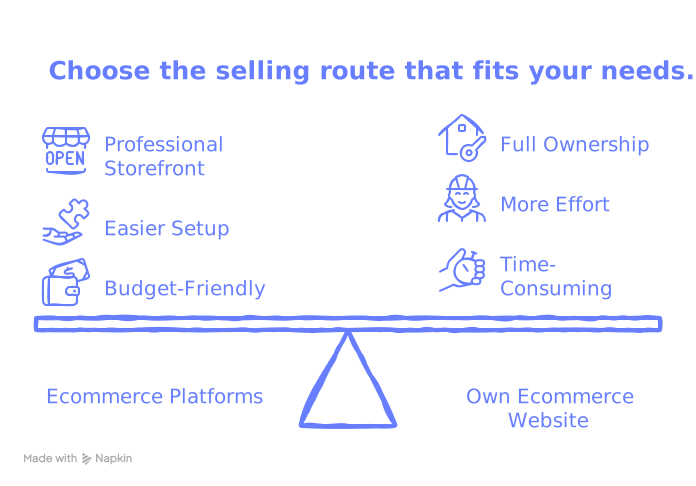
Do you want to sell on a large ecommerce platform, or do you want to create your own online store?
Selling on ecommerce platforms gives you ready traffic and structure. Creating your own ecommerce store gives you control over branding, pricing, and customer relationships. Many first-time sellers start on one route and later move to the other. Both paths are valid.
Step 1: Decide what you want to sell
This step shapes everything else.
Start with products that are
easy to explain
easy to ship
familiar to you
Common starting categories for first-time sellers include clothing, accessories, grocery items, beauty products, health and wellness, and pet supplies. Avoid launching with too many products. A focused catalogue builds trust faster.
Step 2: Choose your selling route
Selling through ecommerce platforms
Platforms such as a Shopify website allow you to create a professional online store with product pages, order management, and payments. You usually need to select a plan, choose a theme, and manage listings.
Creating your own ecommerce website
If you want full ownership, you can buy a domain, choose hosting, and build your website using tools like website builders or content management systems. This gives flexibility but needs more effort.
Both options work. The right choice depends on time, budget, and comfort level.
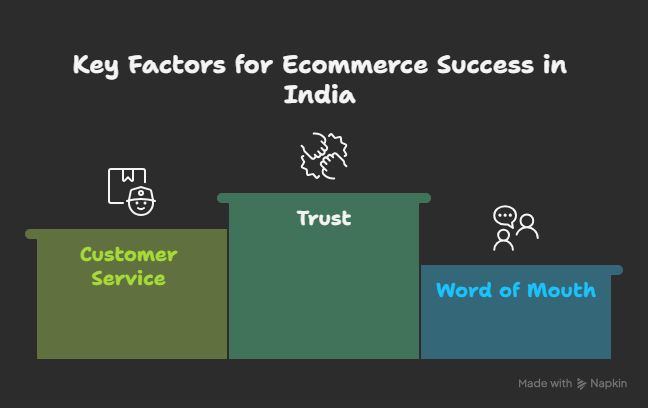
What truly drives ecommerce success in India: strong customer service, built-in trust, and word of mouth that travels faster than ads.
Step 3: Buy a domain and set up your website
A domain is your store’s address on the internet, like yourstore.in.
Approximate costs
domain name: ₹700 to ₹1200 per year
hosting or website builder: ₹3000 to ₹6000 per year
Many ecommerce platforms include hosting, which reduces technical work for beginners.
Step 4: List your products properly
Product listing is where customers decide whether to trust you.
Each product should include
clear product name
simple, honest description
correct pricing
good quality images
You do not need expensive photo shoots. Many sellers now use ai tools to write descriptions and improve images. Tools like ChatGPT or Gemini help create simple product text, while ai image tools help clean backgrounds or adjust lighting. Always keep visuals realistic.
Step 5: Branding and packaging basics
Branding does not mean fancy boxes.
Start with
a simple logo
clean packaging
printed label with store name and contact
Ai tools can help design logos and labels quickly. You can improve packaging slowly as your store grows.
Step 6: Set up payments and upi
Payment convenience is critical for Indian buyers.
Most customers prefer
upi
debit or credit cards
cash on delivery
Payment gateways like Razorpay are commonly used.
Razorpay cost overview:
no setup fee for basic accounts
around 2% to 3% per successful transaction
gst applicable on transaction fees
If you sell a product worth ₹1000, the payment fee is roughly ₹20 to ₹30. You only pay when you receive money, which makes it beginner friendly.
Step 7: Understand platform and website costs
Cost of creating a Shopify website
basic plan: around ₹2000 to ₹3000 per month
domain name: ₹700 to ₹1200 per year
transaction charges apply separately
Optional costs may include paid themes or apps. This option suits sellers who are comfortable with a fixed monthly cost.
Cost of building your own ecommerce website
domain: ₹700 to ₹1200 per year
hosting: ₹3000 to ₹6000 per year
ecommerce tools or plugins: free to paid options
This route is cheaper over time but requires more effort for maintenance and updates.
Step 8: Test everything before launch
Before sharing your store link
place a test order
check payment flow
review product details
This builds confidence and avoids mistakes.
Big question is creating an online store free possible without products
This is one of the most common doubts among first-time sellers.
Traditional ecommerce stores usually need products, packaging, and shipping. However, newer models allow sellers to create a free online store without holding inventory.
Some tools let you start by simply adding your phone number and store name. Products are available from a ready catalogue, packaging and shipping are handled, and you sell using a store link or qr code.
Platforms like Wcommerce follow this approach. They offer a growing range of products across fashion, accessories, grocery, health and wellness, beauty, and pet categories. Many sellers use this model to learn selling without upfront investment.
What matters more than the tools
According to India Brand Equity Foundation reports, India’s ecommerce market has grown steadily due to mobile access and digital payments. For small sellers, this means opportunity, but only if trust is built.
Focus on
replying to customers on time
being honest about delivery
improving listings slowly
In tier 2 and tier 3 cities, word of mouth still matters as much as technology.
In India, ecommerce grows when people trust the seller, feel supported, and recommend the store to others.
Conclusion
Online store setup in 2026 is no longer about technical skills or big investments. It is about choosing a path that fits your time, budget, and confidence level. Some sellers start with ecommerce platforms, some build their own stores, and others begin with inventory-free tools to understand how online selling works in real life.
What matters most is not perfection, but clarity. Knowing your costs, understanding how payments and delivery work, and replying honestly to customers builds trust faster than any feature or design.
Once your store basics are in place, many first-time sellers naturally move towards social selling methods, where WhatsApp, Instagram, and short videos help bring real conversations and inquiries. In India, especially in tier 2 and tier 3 cities, selling grows when people trust the seller, feel supported, and confidently recommend the store to others.
How beginners in India can test a business idea before spending money
Every year, millions of Indians think about starting an online business. The world of online business grew fast from the last decade, and in 2026 it is now part of everyday life in our towns and cities. India has over one billion internet users as of 2025, and more people use phones, apps, and online shopping than ever before. This also means more chances to sell online — but it also means more competition.
For a beginner, the hardest part is not coming up with a business idea. It is knowing whether that idea will work before you spend money. This blog will help you understand simple ways to test your business idea before you invest money, so you avoid loss in online business and start safely.
What does “test before investing money” really mean
Testing your business idea means using small and simple experiments to check if real people are interested in what you want to sell. It does not mean building a full business or buying stock worth thousands of rupees. It means starting small, checking demand, and learning what people actually want.
Imagine someone has an idea, but does not know whether customers will buy it or not. Testing helps answer that question before spending a lot.
Meet Reena, a housewife with a pickle idea
Let us take a simple real life example from a small town in India.
Reena is a housewife. She makes very tasty homemade mango and lemon pickles that everyone in her neighbourhood loves. Friends often told her, “You should sell these online.” But Reena was afraid. What if no one outside her town bought? What if she lost money?
So instead of jumping in, she decided to test her idea.
Step 1: Understanding the problem clearly
Meena asked herself one honest question. Are people outside my circle willing to buy homemade pickles online?
She was not trying to become a big brand. Her goal was only to check demand before starting.
Step 2: Creating a simple online presence
Instead of hiring a developer, she used free templates available on website builders and created a one page website at no cost. The page was very simple and easy to understand. It explained:
what pickle she makes
how it is prepared at home
why it is different from shop pickles
She clearly listed one product to avoid confusion. Homemade mango pickle, 500 grams, priced at 299 rupees.
To make the website look real and trustworthy, she bought a basic domain name: picklesbyreena.in, which cost her around 150 rupees per month for the first year. This was her only fixed cost. She did not buy hosting plans or paid tools. The domain was used only to test demand, not to build a full business.
This step helped her understand how online business ideas from home actually work in real life, without spending much money.
Step 3: Adding a clear action button
Meena added a buy now button on the page. But instead of taking payment, the button led to a simple message saying, sorry, out of stock. we will be in stock soon.
This was intentional. She was not selling yet. She was only testing interest.
The purpose of this button was to check how many visitors actually wanted to buy.
Step 4: Using simple videos and small ads
Meena used her phone to record short videos showing:
pickle preparation
clean kitchen
packing process
She shared these videos on social media. To speed up testing, she spent 50 to 100 rupees per day on simple ads for a few days. She kept the budget low and stopped once she saw enough activity. This was not marketing. This was testing.
This is a small budget business start that many beginners can manage.
Step 5: Understanding clicks and interest
Now comes an important concept.
Out of 100 people who visited her page, more than 5 clicked the buy now button. This means her click through rate, or ctr, was above 5 percent.
In simple terms, ctr tells you how many people showed buying interest after seeing your page. A higher ctr means stronger demand.
For Meena, this was enough proof. People were not just watching. They were trying to buy.
This is how she checked demand before starting, without investing heavily.
Free ways to test your business idea
Not everyone wants to use paid ads right away. Here are free ways to check demand:
share your product videos in community groups
ask people to message you for details
share simple polls asking “are you interested?”
note how many people ask questions or say yes
These help you see real interest without spending any money.
Paid testing that still keeps risk low
If you use paid tests, do it in a controlled way:
set a daily limit like 50 or 100 rupees
stop after a few days once you have enough data
watch how many people click and show interest
This is not real selling yet. This is checking demand before starting an online business.
What testing helps you decide
When you test before investing money, you learn:
whether people outside your neighbourhood care about your product
if your messaging is clear
if your price feels right
whether you should start full business or rethink your idea
This approach becomes part of your beginner online business guide.
Common mistakes many beginners make
Many people go wrong by:
investing big money without any signals
buying stock before checking demand
building a full website before testing
expecting immediate success
Testing helps you avoid these mistakes and plan safely.
A realistic path ahead in 2026
In 2026, online business ideas are growing in India fast, and competition is rising. Many people in tier 2 and tier 3 cities are now shopping online as part of daily life. This means products that solve real needs, show value, and reach the right audience are more likely to succeed.
Instead of spending big money or building everything at once, testing your idea first helps you start with confidence and avoid loss. When you see real interest, then you are ready for the next step — how to set up your first online store step-by-step (no technical skills needed).
Conclusion
Testing your business idea before you invest money helps you start online the smart way. Simple steps like creating a low cost domain, sharing honest videos, running small ad tests, and measuring click through rates show whether people are truly interested. For anyone with an online business idea in 2026, doing small tests first can make the difference between loss and success.
Do not rush. Test small, learn from real interest, and then build your business with clarity.
References
Statista internet usage India report 2025 Shopify editorial insights 2026 Inc42 ecommerce trends 2026
Choosing the right niche in India before you start your online journey
Choosing a profitable niche in India is one of the biggest challenges for anyone starting an online journey. Whether you are a student looking for extra income, a homemaker wanting flexible work, or a small business owner trying to enter the digital space, the first question is always the same: what should I focus on?
With so many online ideas, trends, and advice videos, it is easy to feel confused. But the truth is simple: the niche you choose decides your long-term income, your growth, and your confidence. When your niche matches real market demand and something you genuinely understand, the journey becomes stable and meaningful.
Why choosing a niche matters more today than ever?
A niche is just the main topic, need, or problem you want to solve. It helps you focus your effort instead of trying to do everything. Today’s online world rewards clarity. Customers prefer specialists because it gives them trust, relevance, and better solutions.
A 2024 IAMAI report showed that digital consumption in India continues to rise across all age groups, with strong growth in repeated online purchases. This means people are actively seeking targeted solutions, not broad, generic content or products. For beginners, this shift is a clear signal: a focused niche is more profitable than trying to serve everyone.
What sells online in India and what it means for your niche?
Understanding what sells online is the first step to choosing a profitable niche. This doesn’t mean copying trends but reading demand patterns.
Shiprocket’s 2023 ecommerce study found strong growth in categories like:
beauty and personal care
home improvement
fitness and wellness
regional snacks and foods
pet products
mobile accessories
These categories keep performing well because they solve everyday problems for Indian households. They also show that people spend more on convenience, care, and simple lifestyle upgrades.
When you ask, what can I sell to make money?, the answer is usually hidden inside daily routines. People buy things that make life easier, healthier, or more comfortable.
How to find your niche using demand based niches in India
The easiest way to find a profitable niche is to follow demand. Demand based niches in India simply means choosing topics or products people already search for. Instead of guessing, you observe what people are struggling with or wanting more of.
Some simple ways to identify demand include:
search suggestions
bestseller lists
trending online products
customer reviews
local market gaps in your own area
Shopify’s niche market insights highlight that profitable niches are built around problems, not just passion. If people repeatedly search for solutions, the niche is strong.
The five-step method to pick a profitable niche in India
To fully answer the title question, here is a simple step-by-step process that anyone can follow.
Step 1: Observe what people already spend on
Look at your own home, neighbours, and local stores. What are people buying repeatedly? These patterns often match national demand trends.
Step 2: Check demand using simple signals
You can look at:
search suggestions
bestseller lists on marketplaces
social media comments
product reviews
common frustrations people talk about
If people frequently search or buy something, it has demand.
Step 3: Match demand with your interest or skill
Choose ideas that feel natural to you. A profitable niche must align with:
something you can talk about
something you can explain
something you can improve over time
This reduces burnout and increases consistency.
Step 4: Ensure your idea solves a problem
A niche becomes profitable only when it solves discomfort in people’s daily life. This is why problem solving niches in India perform strongly.
Ask yourself:
does this niche save time?
does it save money?
does it reduce effort?
does it provide comfort or confidence?
If the answer is yes, it is a workable niche.
Step 5: Shortlist three ideas before choosing one
Do not select the first idea you find. Instead:
make a list of three
compare them side-by-side
choose the one with clearer demand and easier content or product ideas
This method ensures your final niche is practical, profitable, and sustainable.
Niche ideas for small towns and tier 2 and tier 3 India
A common mistake is assuming all online trends come from metro cities. In reality, digital adoption is growing fastest in tier 2 and tier 3 regions. These audiences have different needs—practical, value-driven, and family-focused.
Some niche ideas that work well in smaller towns include:
homemade beauty and skincare
local snacks and sweets
simple fitness routines and home workouts
regional clothing and accessories
easy personal finance education
basic digital skills learning
home organisation products
These ideas fit everyday Indian lifestyles and are easier to scale because demand is constant.
Niche trends in India for 2025–26
Based on industry reports from Deloitte India, EY India, and Statista, some growing niche trends include:
sustainable home products
natural wellness and self-care
regional and handmade goods
pet care and grooming
educational micro skills
home cooking and kitchen solutions
These categories show niche growth potential because they match rising Indian consumer behaviour—especially the desire for authenticity, convenience, and affordability.
Understanding niche demand research
Niche demand research helps you avoid choosing ideas that only look interesting but have no buyers. This is where niche demand research becomes important. You can check demand through:
Google search interest
social media conversations
product reviews
repeat purchase behaviour
visible customer frustrations
Statista’s 2024 India ecommerce summary found that repeat orders form a major chunk of ecommerce sales. This means consumers prefer products and categories they trust—another reason to choose niches built on everyday needs.
Filtering niche ideas using simple methods
Once you list a few ideas, filter them using practical steps:
does this niche solve a real problem?
does India have enough audience for it?
can you offer something simple but helpful?
are people already spending money here?
can you start with low investment?
This filtering step removes weak ideas and highlights simple niche ideas that you can start immediately.
Why niche validation matters before you start?
Before committing fully, you must check whether the niche is profitable. This is where product demand check and niche profitability test become your safety net. Many successful creators and sellers use small tests—polls, sample listings, short posts, or trial products—to see if people will respond.
Validation prevents wasted time and ensures your niche has real buyers.
Conclusion
Picking a profitable niche in India is not about chasing viral ideas. It is about understanding what sells online, reading demand signals, and choosing something that fits your experience and comfort. When your niche matches Indian consumer behaviour—especially in tier 2 and tier 3 cities—it becomes easier to grow consistently.
The most practical next step is to shortlist your ideas and observe which one people connect with the most. A niche with clear demand will always be easier to build, easier to scale, and easier to turn into a reliable income stream.
References
Shopify Elementor Shiprocket iValuePlus IAMAI Deloitte India EY India Statista Nasscom
How Indians can find a reliable online income option that fits their life
For many people in India, the idea of online earning sounds both exciting and confusing at the same time. There are so many videos, websites, and opinions that it becomes hard to understand which option is real, which one suits your skills, and how much money you can actually expect to earn. In tier 2 and tier 3 cities, where many families depend on stable monthly income, this confusion feels even bigger. People want something trustworthy, flexible, and safe that they can manage from home without disturbing daily routines.
This article aims to bring clarity. Instead of giving a long list of random ideas, we will understand how to choose the right online income path based on your skills, comfort level, and budget. When you know the right direction, online earning becomes less stressful and more practical.
Why choosing the right income path matters today?
Most people search for online income when they need extra money or want flexible work from home. But the online world is full of noise. Many options look easy on the surface, but they demand skills, patience, or some upfront effort. According to a 2023 survey by the National sample survey office, over one third of young adults in India explored some form of online income in the past year. This shows a rising interest, but it also means more competition.
Choosing the wrong path often leads to frustration. People start something, do not get quick results, and give up. But when your online work matches your skills and budget, it becomes sustainable. You start small, slowly improve, and build income over time.
What affects your online earning range?
When you search for online earning options, you will notice different earning levels like 10k to 100k per month or 1k to 10k per month. These ranges depend on four simple things:
your current skill level
how much time you can give daily
your starting budget
the demand for the work you choose
Understanding these before jumping in helps you avoid disappointment and set realistic goals.
Online earning without investment: great for beginners
If you want online earning without investment, the best approach is to start with skills you already have. These can include writing simple content, basic design, customer support, teaching school subjects, or managing social media pages.
These options usually fall in the online income range of 1k to 10k for beginners because you start small and learn as you go. Over time, as your skills and confidence grow, the income grows too.
Some examples that suit beginners
Content writing: If you enjoy explaining things in simple words, this is a good starting point. Many small businesses look for writers who can write in basic Indian English.
Online tutoring: Students in smaller cities often need help in subjects like maths, english, and science. A stable option for those who enjoy teaching.
Micro tasks: Some online earning websites offer small tasks like surveys or data sorting. These do not pay very high, but they help you understand the online work culture.
These options are slow but safe. They teach discipline and help you understand what kind of online work you enjoy.
Low investment online income paths that grow faster
If you can invest a small amount each month, even something like 500 to 2000, your options increase. Low investment online income choices allow faster learning and better-quality work.
For example:
Learning design or video editing: These are simple online skills to make money because they are in high demand. Short-term courses are affordable, and clients pay better. This falls under high income skills, especially when you specialise in one area.
Social media management: Small businesses, especially in tier 2 and tier 3 cities, need people who can handle posts, messages, and basic marketing. With a low budget for tools, this can grow into a 10k to 100k online earning path over time.
Reselling products: If you can manage a small stock or even use dropshipping platforms, you can earn money from home with low investment.
Low investment does not mean high risk. It simply gives you more control over the quality of your work.
Skills that help you earn more over time
Most successful online earners in India follow one rule: they invest a little time every week to improve their skills. Skills for online earning do not need to be complicated. They just need to match what people are willing to pay for.
Some useful online skills to make money include:
writing simple blogs and website content
basic graphic design
video editing for short videos
social media handling
online teaching
translation
voice-over recording
These skills fall under online work based on skills, which means your income increases as your skills improve. Over time, these turn into dependable online income paths that can reach the 10k to 100k range for consistent workers.
Understanding budget and choosing the right direction
Your budget plays a huge role in choosing online earning options. Here is a simple way to think about it:
if you have zero budget
Start with writing, tutoring, micro tasks, or customer support work. These are safe, simple, and do not require paid tools.
if you have a small budget
Learn a skill that has clear demand. Prioritise video editing, graphic design, social media handling, or basic coding. These help in building stable online income with low budget.
if you have a moderate budget
You can combine skills with small business ideas like online reselling, managing product pages, or offering specialised services. These give higher returns because you control the service quality.
How to compare online earning methods?
Readers often get confused because every option seems good. To avoid this, compare online earning methods using three simple questions:
does this match my current skills?
can I give at least one hour daily?
does this option have demand in my area or online community?
Anything that gets a yes for all three is usually the right choice. Once you’ve chosen the right online earning path based on your skills and budget, the next important step is to identify a profitable niche within that path—something specific that people are actively looking for and willing to pay for.
How online earning fits into real Indian life?
Online income works best when you treat it like a slow and steady routine, not a rush. Many people in tier 2 and tier 3 cities manage online work along with college, job, or household responsibilities. The flexibility helps them balance family work, local travel, and personal commitments.
A 2022 study by the Internet and mobile association of India reported steady growth in online freelancing. This means more opportunities for people who want part-time online earning from home. For readers, this simply means that the online market is becoming more welcoming for beginners.
Conclusion
Choosing the right online earning path becomes easier when you understand your skills, your budget, and the real demand in the market. Instead of jumping into the trend of the moment, pick something that feels natural and manageable in your daily routine. When your work matches your strengths, even small efforts build stable online income over time.
For small businesses and individuals in India, the next practical step is to spend a few days observing what skills you already have and which ones you can improve with low effort. A clear direction saves time, reduces confusion, and sets the foundation for online earning that grows month by month.
Create your store with Wcommerce today and enjoy a zero subscription fee forever. Don't miss this exclusive opportunity to maximize your earnings without any monthly costs.


.png)
.jpg)
.png)
.png)
.jpg)
.jpg)
.jpg)
.jpg)
.jpg)
