Online Earning
-
8
min read
Online sales are growing, but so are returns. Many sellers lose money without knowing the real reasons. Let’s break down what actually causes returns — and how to prevent them smartly.
Subham Kumar
-
February 20, 2026
Starting an online store in 2026 is both easier and harder than before.
Easier, because technology has simplified everything. You can build a website quickly, list products, accept payments, and start selling within days. Harder, because competition is everywhere. Thousands of sellers are fighting for attention on the same platforms.
Most beginners experience the same frustration.
You launch your store with excitement. You share links with friends. You post on social media. Then days pass. Hardly any visitors. Very few orders. Eventually, you hear the most common advice — “run ads”.
For many new sellers, especially those working with very small budgets, ads are not always the right first step. Paid campaigns can be unpredictable. Costs are rising. Margins are tight. One mistake can drain valuable capital.
This is exactly where small content creators become extremely relevant in 2026.
Let us explore this in a practical, realistic, beginner-friendly way.
Consumer behaviour has changed dramatically over the past few years. People now spend a large part of their day watching short videos, reels, and creator content. Instead of discovering products through traditional advertisements, they often encounter them through individuals they follow.
This shift is part of what many industry experts describe as the creator economy for ecommerce — a digital environment where creators influence what audiences notice, trust, and buy.
According to Influencermarketinghub’s industry report in 2023, the global influencer marketing industry crossed 21 billion dollars. For a small store owner, the number itself is not the main point. The real takeaway is the direction of the trend.
Businesses are increasingly investing in creators rather than depending only on ads.
For beginners with limited funds, this opens a highly practical opportunity.
A content creator is simply someone who regularly posts videos, photos, or posts online and has an audience that pays attention to their content.
They are not always celebrities.
They may be:
Their value lies in audience attention and trust.
Followers often view creators as relatable individuals rather than distant brands. This builds a level of credibility that advertisements struggle to achieve.
Many beginners dream of collaborating with large influencers. Big names feel attractive. Large follower counts appear impressive.
However, smaller creators frequently deliver better outcomes for new stores.
Why?
First, their audience connection feels more personal. Followers interact, comment, and engage more genuinely. This helps build audience trust through authentic creators, which is extremely important when your brand is unknown.
Second, smaller creators are easier to approach. They respond to messages. They experiment with collaborations. They are more open to flexible arrangements.
Third, costs are usually manageable for beginners.
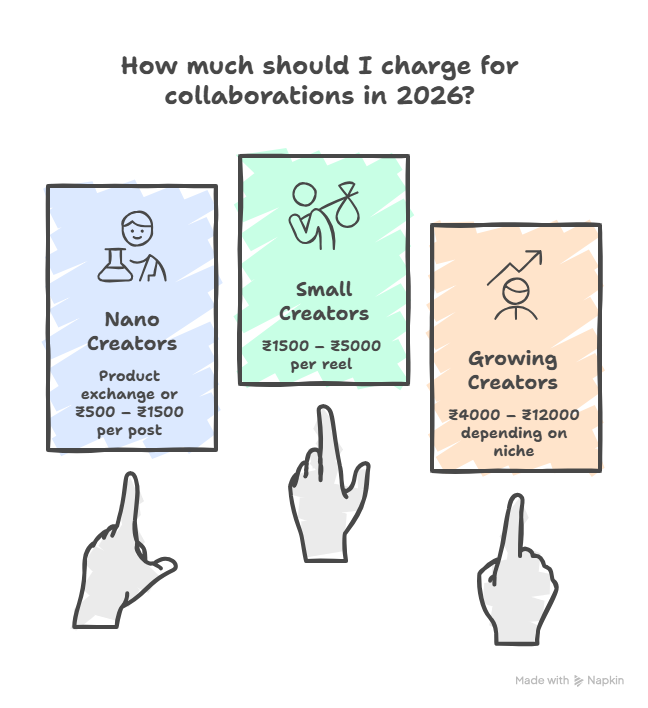
Influencer marketing is often misunderstood as expensive. That assumption mainly comes from observing large creators.
Smaller creators operate very differently.
Broad practical collaboration ranges in India often look like this (general market observations, not strict rules):
Many creators accept free products, especially if the product fits their content style and audience.
For low-budget sellers, product-based content creator collaborations can be an excellent starting point.
Posting on your own social media page is necessary, but reach is limited when your account is new. Algorithms favour engagement history and established profiles.
Creators already possess visibility.
Collaborating with them allows you to tap into audiences that are already active. This makes creator partnerships one of the most practical forms of social media marketing without ads.
Instead of waiting months for organic growth, you gain immediate exposure.
Understanding the strategy is one thing. Executing it is another.
Beginners often struggle with the first step — where do you actually find creators and how do you contact them?
The process is far simpler than it appears.
Instagram remains one of the easiest platforms to discover small video creators.
Simple discovery methods:
Once you find a potential creator, review their profile carefully.
Look for:
Do not focus only on follower count.
A creator with a smaller but engaged audience can be far more valuable.
Many creators share business information directly in their bio.
You may find:
If an email is listed, sending a polite message is usually appropriate.
If no contact details are visible, direct messaging is completely normal.
Keep your message human and respectful.
Example:
“Hi, I recently saw your page and liked your content. I have started a small online store and feel my product may suit your audience. Would you be open to discussing a simple collaboration?”
No pressure. No aggressive sales tone.
Creators respond better to genuine communication.
Youtube is another powerful platform, particularly for niches where detailed explanations matter.
Search using:
Once you open a channel, go to the about section.
Many beginners overlook this.
Creators frequently list business email addresses here.
Emails should be brief and clear.
Avoid sounding like a large corporate brand.
Example structure:
Authenticity works better than formality.
Some creators provide phone numbers or WhatsApp links.
Calling can work, but basic etiquette is important.
Good approach:
Unexpected calls without context may feel intrusive.
Choosing creators can feel confusing for beginners.
Instead of overthinking, use simple filters:
Even creators with modest audiences can generate strong results if trust is high.
Keep collaborations simple and low risk.
Beginner-friendly models:
If budgets are limited, product-based partnerships are often ideal.
This also supports effective UGC strategies, where creators generate natural content for your brand.
New stores struggle primarily with trust.
Unknown brands naturally trigger hesitation. Creator content reduces this friction. When audiences see a familiar individual using or discussing a product, confidence increases.
This is how sellers gradually boost sales with creator content without heavy advertising.
Even strong strategies fail when expectations are unrealistic.
Avoid:
Influencer marketing is a gradual visibility-building process.
Consistency is more important than perfection.
Every week:
Over time, this steady effort compounds.
For many sellers, aggressive ad spending feels risky. Creator partnerships offer flexibility.
You can:
When you pair creator collaborations with simple business analytics— such as tracking engagement, conversions, and responses — decision-making becomes far more confident and less emotional.
This makes creator-driven promotion one of the most realistic small business marketing ideas online.
In 2026, small content creators are not an optional tactic. For beginners with limited budgets, they represent one of the most practical growth channels.
Instead of focusing only on ads, focus on attention and trust. Identify creators your audience already follows. Start simple collaborations. Learn from responses. Scale gradually.
For many new store owners, steady creator partnerships can deliver more stable and sustainable growth than unpredictable advertising campaigns.
Starting an online store in 2026 is both easier and harder than before.
Easier, because technology has simplified everything. You can build a website quickly, list products, accept payments, and start selling within days. Harder, because competition is everywhere. Thousands of sellers are fighting for attention on the same platforms.
Most beginners experience the same frustration.
You launch your store with excitement. You share links with friends. You post on social media. Then days pass. Hardly any visitors. Very few orders. Eventually, you hear the most common advice — “run ads”.
For many new sellers, especially those working with very small budgets, ads are not always the right first step. Paid campaigns can be unpredictable. Costs are rising. Margins are tight. One mistake can drain valuable capital.
This is exactly where small content creators become extremely relevant in 2026.
Let us explore this in a practical, realistic, beginner-friendly way.
Consumer behaviour has changed dramatically over the past few years. People now spend a large part of their day watching short videos, reels, and creator content. Instead of discovering products through traditional advertisements, they often encounter them through individuals they follow.
This shift is part of what many industry experts describe as the creator economy for ecommerce — a digital environment where creators influence what audiences notice, trust, and buy.
According to Influencermarketinghub’s industry report in 2023, the global influencer marketing industry crossed 21 billion dollars. For a small store owner, the number itself is not the main point. The real takeaway is the direction of the trend.
Businesses are increasingly investing in creators rather than depending only on ads.
For beginners with limited funds, this opens a highly practical opportunity.
A content creator is simply someone who regularly posts videos, photos, or posts online and has an audience that pays attention to their content.
They are not always celebrities.
They may be:
Their value lies in audience attention and trust.
Followers often view creators as relatable individuals rather than distant brands. This builds a level of credibility that advertisements struggle to achieve.
Many beginners dream of collaborating with large influencers. Big names feel attractive. Large follower counts appear impressive.
However, smaller creators frequently deliver better outcomes for new stores.
Why?
First, their audience connection feels more personal. Followers interact, comment, and engage more genuinely. This helps build audience trust through authentic creators, which is extremely important when your brand is unknown.
Second, smaller creators are easier to approach. They respond to messages. They experiment with collaborations. They are more open to flexible arrangements.
Third, costs are usually manageable for beginners.
Influencer marketing is often misunderstood as expensive. That assumption mainly comes from observing large creators.
Smaller creators operate very differently.
Broad practical collaboration ranges in India often look like this (general market observations, not strict rules):
Many creators accept free products, especially if the product fits their content style and audience.
For low-budget sellers, product-based content creator collaborations can be an excellent starting point.
Posting on your own social media page is necessary, but reach is limited when your account is new. Algorithms favour engagement history and established profiles.
Creators already possess visibility.
Collaborating with them allows you to tap into audiences that are already active. This makes creator partnerships one of the most practical forms of social media marketing without ads.
Instead of waiting months for organic growth, you gain immediate exposure.
Understanding the strategy is one thing. Executing it is another.
Beginners often struggle with the first step — where do you actually find creators and how do you contact them?
The process is far simpler than it appears.
Instagram remains one of the easiest platforms to discover small video creators.
Simple discovery methods:
Once you find a potential creator, review their profile carefully.
Look for:
Do not focus only on follower count.
A creator with a smaller but engaged audience can be far more valuable.
Many creators share business information directly in their bio.
You may find:
If an email is listed, sending a polite message is usually appropriate.
If no contact details are visible, direct messaging is completely normal.
Keep your message human and respectful.
Example:
“Hi, I recently saw your page and liked your content. I have started a small online store and feel my product may suit your audience. Would you be open to discussing a simple collaboration?”
No pressure. No aggressive sales tone.
Creators respond better to genuine communication.
Youtube is another powerful platform, particularly for niches where detailed explanations matter.
Search using:
Once you open a channel, go to the about section.
Many beginners overlook this.
Creators frequently list business email addresses here.
Emails should be brief and clear.
Avoid sounding like a large corporate brand.
Example structure:
Authenticity works better than formality.
Some creators provide phone numbers or WhatsApp links.
Calling can work, but basic etiquette is important.
Good approach:
Unexpected calls without context may feel intrusive.
Choosing creators can feel confusing for beginners.
Instead of overthinking, use simple filters:
Even creators with modest audiences can generate strong results if trust is high.
Keep collaborations simple and low risk.
Beginner-friendly models:
If budgets are limited, product-based partnerships are often ideal.
This also supports effective UGC strategies, where creators generate natural content for your brand.
New stores struggle primarily with trust.
Unknown brands naturally trigger hesitation. Creator content reduces this friction. When audiences see a familiar individual using or discussing a product, confidence increases.
This is how sellers gradually boost sales with creator content without heavy advertising.
Even strong strategies fail when expectations are unrealistic.
Avoid:
Influencer marketing is a gradual visibility-building process.
Consistency is more important than perfection.
Every week:
Over time, this steady effort compounds.
For many sellers, aggressive ad spending feels risky. Creator partnerships offer flexibility.
You can:
When you pair creator collaborations with simple business analytics— such as tracking engagement, conversions, and responses — decision-making becomes far more confident and less emotional.
This makes creator-driven promotion one of the most realistic small business marketing ideas online.
In 2026, small content creators are not an optional tactic. For beginners with limited budgets, they represent one of the most practical growth channels.
Instead of focusing only on ads, focus on attention and trust. Identify creators your audience already follows. Start simple collaborations. Learn from responses. Scale gradually.
For many new store owners, steady creator partnerships can deliver more stable and sustainable growth than unpredictable advertising campaigns.
Starting an online store in 2026 is both easier and harder than before.
Easier, because technology has simplified everything. You can build a website quickly, list products, accept payments, and start selling within days. Harder, because competition is everywhere. Thousands of sellers are fighting for attention on the same platforms.
Most beginners experience the same frustration.
You launch your store with excitement. You share links with friends. You post on social media. Then days pass. Hardly any visitors. Very few orders. Eventually, you hear the most common advice — “run ads”.
For many new sellers, especially those working with very small budgets, ads are not always the right first step. Paid campaigns can be unpredictable. Costs are rising. Margins are tight. One mistake can drain valuable capital.
This is exactly where small content creators become extremely relevant in 2026.
Let us explore this in a practical, realistic, beginner-friendly way.
Consumer behaviour has changed dramatically over the past few years. People now spend a large part of their day watching short videos, reels, and creator content. Instead of discovering products through traditional advertisements, they often encounter them through individuals they follow.
This shift is part of what many industry experts describe as the creator economy for ecommerce — a digital environment where creators influence what audiences notice, trust, and buy.
According to Influencermarketinghub’s industry report in 2023, the global influencer marketing industry crossed 21 billion dollars. For a small store owner, the number itself is not the main point. The real takeaway is the direction of the trend.
Businesses are increasingly investing in creators rather than depending only on ads.
For beginners with limited funds, this opens a highly practical opportunity.
A content creator is simply someone who regularly posts videos, photos, or posts online and has an audience that pays attention to their content.
They are not always celebrities.
They may be:
Their value lies in audience attention and trust.
Followers often view creators as relatable individuals rather than distant brands. This builds a level of credibility that advertisements struggle to achieve.
Many beginners dream of collaborating with large influencers. Big names feel attractive. Large follower counts appear impressive.
However, smaller creators frequently deliver better outcomes for new stores.
Why?
First, their audience connection feels more personal. Followers interact, comment, and engage more genuinely. This helps build audience trust through authentic creators, which is extremely important when your brand is unknown.
Second, smaller creators are easier to approach. They respond to messages. They experiment with collaborations. They are more open to flexible arrangements.
Third, costs are usually manageable for beginners.
Influencer marketing is often misunderstood as expensive. That assumption mainly comes from observing large creators.
Smaller creators operate very differently.
Broad practical collaboration ranges in India often look like this (general market observations, not strict rules):
Many creators accept free products, especially if the product fits their content style and audience.
For low-budget sellers, product-based content creator collaborations can be an excellent starting point.
Posting on your own social media page is necessary, but reach is limited when your account is new. Algorithms favour engagement history and established profiles.
Creators already possess visibility.
Collaborating with them allows you to tap into audiences that are already active. This makes creator partnerships one of the most practical forms of social media marketing without ads.
Instead of waiting months for organic growth, you gain immediate exposure.
Understanding the strategy is one thing. Executing it is another.
Beginners often struggle with the first step — where do you actually find creators and how do you contact them?
The process is far simpler than it appears.
Instagram remains one of the easiest platforms to discover small video creators.
Simple discovery methods:
Once you find a potential creator, review their profile carefully.
Look for:
Do not focus only on follower count.
A creator with a smaller but engaged audience can be far more valuable.
Many creators share business information directly in their bio.
You may find:
If an email is listed, sending a polite message is usually appropriate.
If no contact details are visible, direct messaging is completely normal.
Keep your message human and respectful.
Example:
“Hi, I recently saw your page and liked your content. I have started a small online store and feel my product may suit your audience. Would you be open to discussing a simple collaboration?”
No pressure. No aggressive sales tone.
Creators respond better to genuine communication.
Youtube is another powerful platform, particularly for niches where detailed explanations matter.
Search using:
Once you open a channel, go to the about section.
Many beginners overlook this.
Creators frequently list business email addresses here.
Emails should be brief and clear.
Avoid sounding like a large corporate brand.
Example structure:
Authenticity works better than formality.
Some creators provide phone numbers or WhatsApp links.
Calling can work, but basic etiquette is important.
Good approach:
Unexpected calls without context may feel intrusive.
Choosing creators can feel confusing for beginners.
Instead of overthinking, use simple filters:
Even creators with modest audiences can generate strong results if trust is high.
Keep collaborations simple and low risk.
Beginner-friendly models:
If budgets are limited, product-based partnerships are often ideal.
This also supports effective UGC strategies, where creators generate natural content for your brand.
New stores struggle primarily with trust.
Unknown brands naturally trigger hesitation. Creator content reduces this friction. When audiences see a familiar individual using or discussing a product, confidence increases.
This is how sellers gradually boost sales with creator content without heavy advertising.
Even strong strategies fail when expectations are unrealistic.
Avoid:
Influencer marketing is a gradual visibility-building process.
Consistency is more important than perfection.
Every week:
Over time, this steady effort compounds.
For many sellers, aggressive ad spending feels risky. Creator partnerships offer flexibility.
You can:
When you pair creator collaborations with simple business analytics— such as tracking engagement, conversions, and responses — decision-making becomes far more confident and less emotional.
This makes creator-driven promotion one of the most realistic small business marketing ideas online.
In 2026, small content creators are not an optional tactic. For beginners with limited budgets, they represent one of the most practical growth channels.
Instead of focusing only on ads, focus on attention and trust. Identify creators your audience already follows. Start simple collaborations. Learn from responses. Scale gradually.
For many new store owners, steady creator partnerships can deliver more stable and sustainable growth than unpredictable advertising campaigns.
.png)
.jpg)