Online Earning
-
8
min read
Online sales are growing, but so are returns. Many sellers lose money without knowing the real reasons. Let’s break down what actually causes returns — and how to prevent them smartly.
Subham Kumar
-
February 20, 2026
Selling online in India in 2026 is exciting, fast-moving, and full of opportunities. But let’s speak honestly, like two business friends having chai — every seller eventually faces the challenge of returns. One week you are happy seeing fresh orders, the next week you are processing refund requests, return orders, and customer complaints.
If you are a small or medium seller, especially working from a tier 2 or tier 3 city, this issue feels even heavier. You are not running a giant warehouse with separate teams. You are often doing everything yourself — listing products, packing parcels, answering customer messages, and managing returns.
So let’s break this down in simple, practical language.
No complicated theories. Just real reasons and realistic solutions.
Returns are no longer an occasional inconvenience. They are now a built-in part of online selling.
Across ecommerce markets worldwide, studies have repeatedly shown that roughly 20 percent of online purchases get returned. In categories like fashion and lifestyle, return rates often cross 30 percent because of sizing and expectation issues.
What does this mean for a seller in simple words?
If you ship 100 products, you may see 20 to 30 coming back.
For a small seller, that is not just numbers on paper. That is blocked money, double logistics cost, packaging waste, and extra workload.
In India, returns carry a few additional behavioural patterns that sellers must understand.
Large marketplaces are designed to absorb return losses. Small businesses are not.
Each returned order usually means:
For many growing online sellers, reducing returns becomes more profitable than increasing sales.
A product return happens when a buyer sends back a delivered item and asks for a refund or replacement.
Returns are normal in ecommerce. But frequent return orders usually indicate deeper problems — unclear listings, mismatched expectations, quality concerns, or delivery confusion.
Understanding why customers return products is the first step toward prevention.
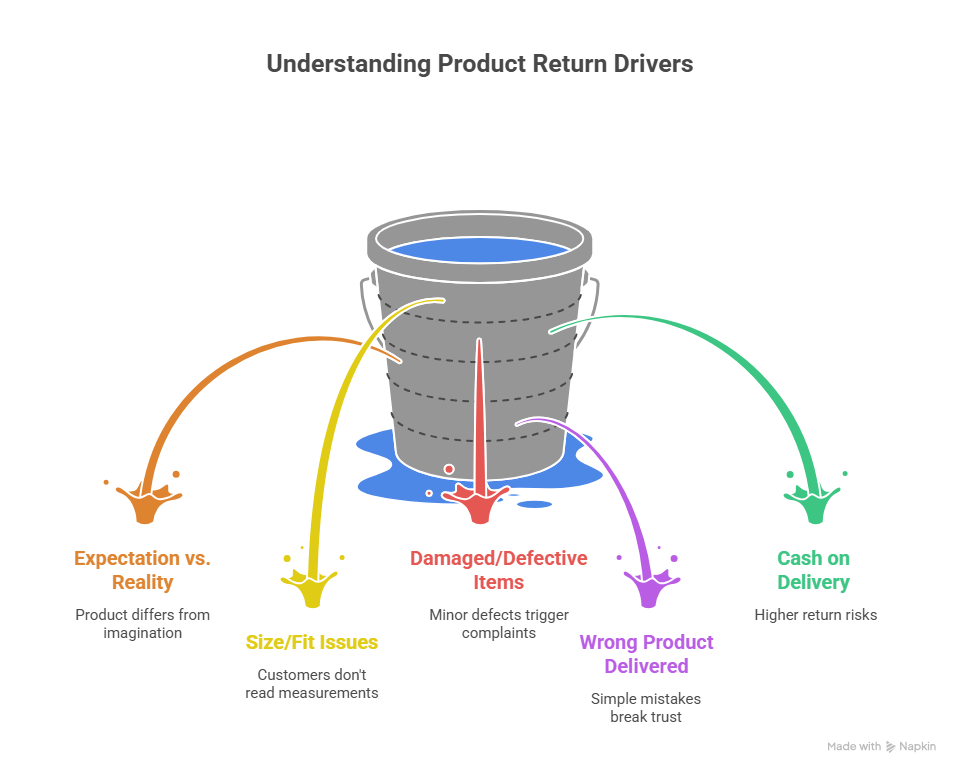
Returns rarely happen without cause. Customers usually react to specific disappointments.
This is one of the biggest drivers of return orders.
Online buyers depend heavily on product photos and short descriptions. If the delivered product looks different, feels different, or performs differently than imagined, dissatisfaction begins.
For example:
A buyer orders a “premium cotton shirt” expecting thick fabric but receives a lighter material. Even if the product is technically correct, perception drives the return.
This is why better product descriptions and visuals matter more than many sellers realise.
Very common in clothing, footwear, and accessories.
Many customers do not carefully read measurement details. Some order multiple sizes planning to return unwanted ones. In fashion categories, higher return percentages are now a well-known trend.
In smaller cities, buyers often rely more on images than technical specifications.
Accurate product information reduces returns significantly.
Even minor defects can trigger customer complaints and return requests.
From the buyer’s perspective, responsibility always lies with the seller. Courier mishandling is rarely considered by customers.
Strong packaging quietly plays a major role in reducing return orders.
Simple mistakes — wrong colour, wrong variant, wrong size — instantly break trust.
Repeated fulfilment errors often result in rising customer complaints and falling repeat purchases.
Cash on delivery continues to influence buying decisions in India.
While customers love its convenience, sellers often face:
Industry observations over recent years consistently highlight that cash on delivery orders usually carry higher return risks than prepaid ones.
For sellers, this is not about avoiding cash on delivery — it is about managing expectations better.
Reducing returns is less about expensive software and more about clarity, honesty, and buyer psychology.
Think like a careful buyer.
Ask:
Avoid generic phrases like “best quality.” Instead, describe what the buyer will actually receive.
Customers return products less when expectations are realistic.
Images shape buyer perception more than descriptions.
Include:
Over-edited visuals may increase initial orders but often increase return orders later.
Whenever possible:
Especially important for apparel and electronics.
Confusing policies create distrust.
A good return policy:
Clarity reduces unnecessary customer complaints.
Post-purchase communication strategies are highly underrated.
A simple reassurance message can reduce confusion:
“Your order has been packed. Please review size and variant details in your order summary.”
Small gestures often prevent surprise-driven return orders.
Returns contain valuable feedback.
Even a basic tracking sheet noting:
can reveal powerful insights.
For example:
If many buyers say “colour looks different,” the issue may be product photos rather than product quality.
This is practical ecommerce returns data analysis — simple yet effective.
Returns frequently come with customer complaints. These interactions may feel tense, but calm communication works best.
A smart approach:
In India, seller behaviour strongly influences customer trust and repeat buying decisions.
High returns quietly damage business performance:
Research and industry studies repeatedly highlight that customer experience quality strongly affects repeat purchase behaviour. Fewer returns often indicate better trust and clearer expectations.
Returns are not disappearing anytime soon. Online buying behaviour continues to evolve, but customer expectations remain high.
Instead of viewing returns purely as losses, treat them as signals.
Each return silently answers:
“What did the customer expect but did not receive?”
Today, many small businesses create their online stores using specialised platforms rather than managing everything manually. Some modern commerce platforms even handle complex processes like order returns and reverse logistics, allowing sellers to focus more on selling, marketing, and customer relationships instead of operational stress. For growing sellers, this often becomes a practical and less stressful alternative.
For Indian online sellers, most return orders are predictable and preventable. They usually stem from unclear listings, expectation gaps, sizing confusion, and communication gaps.
A smarter strategy is not just increasing sales, but actively working to reduce returns through better clarity and consistency.
Two realistic actions you can take immediately:
Small improvements here often produce stronger financial impact than many promotional efforts.
.jpg)
Selling online in India in 2026 is exciting, fast-moving, and full of opportunities. But let’s speak honestly, like two business friends having chai — every seller eventually faces the challenge of returns. One week you are happy seeing fresh orders, the next week you are processing refund requests, return orders, and customer complaints.
If you are a small or medium seller, especially working from a tier 2 or tier 3 city, this issue feels even heavier. You are not running a giant warehouse with separate teams. You are often doing everything yourself — listing products, packing parcels, answering customer messages, and managing returns.
So let’s break this down in simple, practical language.
No complicated theories. Just real reasons and realistic solutions.
Returns are no longer an occasional inconvenience. They are now a built-in part of online selling.
Across ecommerce markets worldwide, studies have repeatedly shown that roughly 20 percent of online purchases get returned. In categories like fashion and lifestyle, return rates often cross 30 percent because of sizing and expectation issues.
What does this mean for a seller in simple words?
If you ship 100 products, you may see 20 to 30 coming back.
For a small seller, that is not just numbers on paper. That is blocked money, double logistics cost, packaging waste, and extra workload.
In India, returns carry a few additional behavioural patterns that sellers must understand.
Large marketplaces are designed to absorb return losses. Small businesses are not.
Each returned order usually means:
For many growing online sellers, reducing returns becomes more profitable than increasing sales.
A product return happens when a buyer sends back a delivered item and asks for a refund or replacement.
Returns are normal in ecommerce. But frequent return orders usually indicate deeper problems — unclear listings, mismatched expectations, quality concerns, or delivery confusion.
Understanding why customers return products is the first step toward prevention.
Returns rarely happen without cause. Customers usually react to specific disappointments.
This is one of the biggest drivers of return orders.
Online buyers depend heavily on product photos and short descriptions. If the delivered product looks different, feels different, or performs differently than imagined, dissatisfaction begins.
For example:
A buyer orders a “premium cotton shirt” expecting thick fabric but receives a lighter material. Even if the product is technically correct, perception drives the return.
This is why better product descriptions and visuals matter more than many sellers realise.
Very common in clothing, footwear, and accessories.
Many customers do not carefully read measurement details. Some order multiple sizes planning to return unwanted ones. In fashion categories, higher return percentages are now a well-known trend.
In smaller cities, buyers often rely more on images than technical specifications.
Accurate product information reduces returns significantly.
Even minor defects can trigger customer complaints and return requests.
From the buyer’s perspective, responsibility always lies with the seller. Courier mishandling is rarely considered by customers.
Strong packaging quietly plays a major role in reducing return orders.
Simple mistakes — wrong colour, wrong variant, wrong size — instantly break trust.
Repeated fulfilment errors often result in rising customer complaints and falling repeat purchases.
Cash on delivery continues to influence buying decisions in India.
While customers love its convenience, sellers often face:
Industry observations over recent years consistently highlight that cash on delivery orders usually carry higher return risks than prepaid ones.
For sellers, this is not about avoiding cash on delivery — it is about managing expectations better.
Reducing returns is less about expensive software and more about clarity, honesty, and buyer psychology.
Think like a careful buyer.
Ask:
Avoid generic phrases like “best quality.” Instead, describe what the buyer will actually receive.
Customers return products less when expectations are realistic.
Images shape buyer perception more than descriptions.
Include:
Over-edited visuals may increase initial orders but often increase return orders later.
Whenever possible:
Especially important for apparel and electronics.
Confusing policies create distrust.
A good return policy:
Clarity reduces unnecessary customer complaints.
Post-purchase communication strategies are highly underrated.
A simple reassurance message can reduce confusion:
“Your order has been packed. Please review size and variant details in your order summary.”
Small gestures often prevent surprise-driven return orders.
Returns contain valuable feedback.
Even a basic tracking sheet noting:
can reveal powerful insights.
For example:
If many buyers say “colour looks different,” the issue may be product photos rather than product quality.
This is practical ecommerce returns data analysis — simple yet effective.
Returns frequently come with customer complaints. These interactions may feel tense, but calm communication works best.
A smart approach:
In India, seller behaviour strongly influences customer trust and repeat buying decisions.
High returns quietly damage business performance:
Research and industry studies repeatedly highlight that customer experience quality strongly affects repeat purchase behaviour. Fewer returns often indicate better trust and clearer expectations.
Returns are not disappearing anytime soon. Online buying behaviour continues to evolve, but customer expectations remain high.
Instead of viewing returns purely as losses, treat them as signals.
Each return silently answers:
“What did the customer expect but did not receive?”
Today, many small businesses create their online stores using specialised platforms rather than managing everything manually. Some modern commerce platforms even handle complex processes like order returns and reverse logistics, allowing sellers to focus more on selling, marketing, and customer relationships instead of operational stress. For growing sellers, this often becomes a practical and less stressful alternative.
For Indian online sellers, most return orders are predictable and preventable. They usually stem from unclear listings, expectation gaps, sizing confusion, and communication gaps.
A smarter strategy is not just increasing sales, but actively working to reduce returns through better clarity and consistency.
Two realistic actions you can take immediately:
Small improvements here often produce stronger financial impact than many promotional efforts.
Selling online in India in 2026 is exciting, fast-moving, and full of opportunities. But let’s speak honestly, like two business friends having chai — every seller eventually faces the challenge of returns. One week you are happy seeing fresh orders, the next week you are processing refund requests, return orders, and customer complaints.
If you are a small or medium seller, especially working from a tier 2 or tier 3 city, this issue feels even heavier. You are not running a giant warehouse with separate teams. You are often doing everything yourself — listing products, packing parcels, answering customer messages, and managing returns.
So let’s break this down in simple, practical language.
No complicated theories. Just real reasons and realistic solutions.
Returns are no longer an occasional inconvenience. They are now a built-in part of online selling.
Across ecommerce markets worldwide, studies have repeatedly shown that roughly 20 percent of online purchases get returned. In categories like fashion and lifestyle, return rates often cross 30 percent because of sizing and expectation issues.
What does this mean for a seller in simple words?
If you ship 100 products, you may see 20 to 30 coming back.
For a small seller, that is not just numbers on paper. That is blocked money, double logistics cost, packaging waste, and extra workload.
In India, returns carry a few additional behavioural patterns that sellers must understand.
Large marketplaces are designed to absorb return losses. Small businesses are not.
Each returned order usually means:
For many growing online sellers, reducing returns becomes more profitable than increasing sales.
A product return happens when a buyer sends back a delivered item and asks for a refund or replacement.
Returns are normal in ecommerce. But frequent return orders usually indicate deeper problems — unclear listings, mismatched expectations, quality concerns, or delivery confusion.
Understanding why customers return products is the first step toward prevention.
Returns rarely happen without cause. Customers usually react to specific disappointments.
This is one of the biggest drivers of return orders.
Online buyers depend heavily on product photos and short descriptions. If the delivered product looks different, feels different, or performs differently than imagined, dissatisfaction begins.
For example:
A buyer orders a “premium cotton shirt” expecting thick fabric but receives a lighter material. Even if the product is technically correct, perception drives the return.
This is why better product descriptions and visuals matter more than many sellers realise.
Very common in clothing, footwear, and accessories.
Many customers do not carefully read measurement details. Some order multiple sizes planning to return unwanted ones. In fashion categories, higher return percentages are now a well-known trend.
In smaller cities, buyers often rely more on images than technical specifications.
Accurate product information reduces returns significantly.
Even minor defects can trigger customer complaints and return requests.
From the buyer’s perspective, responsibility always lies with the seller. Courier mishandling is rarely considered by customers.
Strong packaging quietly plays a major role in reducing return orders.
Simple mistakes — wrong colour, wrong variant, wrong size — instantly break trust.
Repeated fulfilment errors often result in rising customer complaints and falling repeat purchases.
Cash on delivery continues to influence buying decisions in India.
While customers love its convenience, sellers often face:
Industry observations over recent years consistently highlight that cash on delivery orders usually carry higher return risks than prepaid ones.
For sellers, this is not about avoiding cash on delivery — it is about managing expectations better.
Reducing returns is less about expensive software and more about clarity, honesty, and buyer psychology.
Think like a careful buyer.
Ask:
Avoid generic phrases like “best quality.” Instead, describe what the buyer will actually receive.
Customers return products less when expectations are realistic.
Images shape buyer perception more than descriptions.
Include:
Over-edited visuals may increase initial orders but often increase return orders later.
Whenever possible:
Especially important for apparel and electronics.
Confusing policies create distrust.
A good return policy:
Clarity reduces unnecessary customer complaints.
Post-purchase communication strategies are highly underrated.
A simple reassurance message can reduce confusion:
“Your order has been packed. Please review size and variant details in your order summary.”
Small gestures often prevent surprise-driven return orders.
Returns contain valuable feedback.
Even a basic tracking sheet noting:
can reveal powerful insights.
For example:
If many buyers say “colour looks different,” the issue may be product photos rather than product quality.
This is practical ecommerce returns data analysis — simple yet effective.
Returns frequently come with customer complaints. These interactions may feel tense, but calm communication works best.
A smart approach:
In India, seller behaviour strongly influences customer trust and repeat buying decisions.
High returns quietly damage business performance:
Research and industry studies repeatedly highlight that customer experience quality strongly affects repeat purchase behaviour. Fewer returns often indicate better trust and clearer expectations.
Returns are not disappearing anytime soon. Online buying behaviour continues to evolve, but customer expectations remain high.
Instead of viewing returns purely as losses, treat them as signals.
Each return silently answers:
“What did the customer expect but did not receive?”
Today, many small businesses create their online stores using specialised platforms rather than managing everything manually. Some modern commerce platforms even handle complex processes like order returns and reverse logistics, allowing sellers to focus more on selling, marketing, and customer relationships instead of operational stress. For growing sellers, this often becomes a practical and less stressful alternative.
For Indian online sellers, most return orders are predictable and preventable. They usually stem from unclear listings, expectation gaps, sizing confusion, and communication gaps.
A smarter strategy is not just increasing sales, but actively working to reduce returns through better clarity and consistency.
Two realistic actions you can take immediately:
Small improvements here often produce stronger financial impact than many promotional efforts.
.png)